Dazardbet
Online Poker in Australia 2026 Formats

Online Poker in Australia 2026: Formats, Rules, Regulation, Payments and Player Protection

Last updated: August 2026 · Reviewed by: the editorial research desk, using Australian regulator publications, government reports and peer-reviewed prevalence studies published between 2023 and 2026.

Online poker sits in an unusual position in Australia. Millions of Australians know the rules of Texas Hold'em, the country produces world-class tournament players, and free-to-play poker apps are entirely legal. At the same time, real-money online poker cannot lawfully be offered to anyone physically located in Australia, and the Australian Communications and Media Authority (ACMA) actively blocks the poker sites that try.

This guide does two things at once. It explains the game properly: the formats, the street-by-street mechanics, the maths of rake versus house edge, live dealer technology, bankroll standards. It also explains the legal and harm-minimisation context that any Australian reader needs before they type a card room's name into a browser.

Key takeaways

  • Real-money interactive poker offered to Australian residents is a prohibited service under the Interactive Gambling Act 2001 (IGA), regardless of where the operator is based.
  • Since 11 June 2024, credit cards, credit-linked products and digital currency cannot be used for interactive wagering with licensed Australian providers.
  • Recreational winnings are generally not taxable in Australia. Professional play can be assessed as a business, and income from illegal activity is taxable while related losses are not deductible.
  • Legal alternatives include social and club platforms such as ClubGG and Replay Poker, which use virtual chips only.
  • Simulated gambling in video games has required an R18+ classification since 22 September 2024.
  • Support is free and confidential: National Gambling Helpline 1800 858 858, and self-exclusion through BetStop.
Table of ContentCloseOpen

Gambling participation and harm in Australia

Poker is a skill-weighted game, but it is still a gambling product, and the Australian evidence base on harm is unusually strong. Any honest poker guide has to start here rather than with bonus offers.

National prevalence and risk profiles

Gambling participation in Australia remains high across age groups and product types. In plain terms, this is a mainstream activity, not a niche one.

«About 15% of Australian adults are at risk of gambling harm, with roughly 550,000 people classified as high-risk gamblers.» - National Gambling Prevalence Study Pilot 2024, Australian Institute of Family Studies. https://aifs.gov.au/resources/research-and-statistics/national-gambling-prevalence-study-pilot-2024

Risk is not evenly spread. The same pilot study links higher-intensity gambling with measurable financial stress.

«65.9% of high-risk gamblers report financial difficulties, compared with 24.1% among low-risk gamblers.» - National Gambling Prevalence Study Pilot 2024, Australian Institute of Family Studies. https://aifs.gov.au/resources/research-and-statistics/national-gambling-prevalence-study-pilot-2024

For poker specifically, the practical reading is this. The players most likely to be harmed are not the ones playing one $10 tournament a month. They are the ones grinding long, unbounded cash-game sessions with no loss limit, no session clock and no separation between bankroll and household money.

State-level surveys: NSW Gambling Survey 2024

State surveys add product-level detail. In New South Wales, participation shifted between categories: down for some venue-based products, up for lottery tickets, sports betting and online casino games.

«One in five NSW residents (21%) experienced gambling harm; online casino games and online poker rank among the most harmful forms.» - NSW Gambling Survey 2024, Central Queensland University for GambleAware NSW. https://www.gambleaware.nsw.gov.au/research-and-resources/nsw-gambling-survey-2024

That finding matters, because online poker is often marketed as the «skill» exception to gambling harm. The NSW data does not support that framing. Speed of play, session length, multi-tabling and instant re-buys are precisely the structural features that increase exposure.

Financial losses and harm minimisation funding

The scale of money moving through Australian gambling dwarfs the resources spent protecting players. One state's figures make the ratio hard to ignore: billions in losses against tens of millions in harm reduction.

«In 2022–23 Queensland gambling turnover was about $56.5 billion, player losses $6.1 billion, and harm-minimisation funding just $11.9 million.» - Queensland Audit Office, Minimising gambling harm, Report 9: 2023–24. https://www.qao.qld.gov.au/reports-resources/reports-parliament/minimising-gambling-harm

Self-exclusion and consumer protection: BetStop

BetStop is Australia's National Self-Exclusion Register. Once you register, licensed Australian wagering providers must not open an account for you or send you marketing for the duration you choose, from three months to a lifetime. Registration takes minutes, and it applies across all licensed operators at once rather than site by site.

«By December 2025, 53,308 Australians had registered with BetStop; in its first year the register processed more than 15.8 billion operator checks.» - BetStop Statutory Review, December 2025; Responsible Wagering Australia submission. https://www.acma.gov.au/betstop-national-self-exclusion-register-review

One important limitation for poker players. BetStop binds licensed Australian providers. Offshore poker rooms operating unlawfully are not connected to the register, which is one more reason offshore play carries risk that regulated wagering does not.

Regulatory environment for online poker

The Interactive Gambling Act and prohibited services

The Interactive Gambling Act 2001 (Cth) makes it an offence to provide certain interactive gambling services to customers physically present in Australia. Prohibited services include casino-style games such as online poker, online roulette, online blackjack and virtual slot machines. Readers comparing formats may also want to understand how the same rules apply to online casinos in Australia, because the prohibition is drafted around the product, not the brand.

Amendments in 2017, 2019 and 2023–24 tightened the regime considerably:

Dazardbet heading-banner
  • 2017 (Amendment Act):closed the «grey market» argument used by offshore operators and gave ACMA civil enforcement powers, including large civil penalties and website blocking referrals.
  • 2019:introduced the framework that led to the National Consumer Protection Framework and, ultimately, BetStop.
  • 2023–24:banned credit cards, credit-related products and digital currency for interactive wagering, effective 11 June 2024.
What remains lawful for Australians state-licensed

What remains lawful for Australians: state-licensed sports and race wagering, lotteries and keno through licensed providers, land-based poker in casinos, pubs and clubs under state law, and free-to-play or social poker with no real-money stake or cash-out.

What is unlawful to offer to Australians: real-money online poker, whether peer-to-peer or house-banked. Note the asymmetry that trips up many readers. The IGA targets the operator, not the individual player. Australians are not prosecuted for playing, yet they play with none of the consumer protections that apply to licensed products.

Advertising restrictions and bans on harmful products

Across Commonwealth and state policy documents, gambling harm is treated as a public health concern. That is why advertising, inducement and payment restrictions have expanded faster than product liberalisation.

«Australians lost more than $32 billion on legal gambling in 2023–24, the highest per-capita losses in the world, about $1,521 per adult.» - You win some, you lose more, Australian Government response, May 2026. https://www.aph.gov.au/Parliamentary_Business/Committees/House/Social_Policy_and_Legal_Affairs/OnlineGambling/Government_Response

ACMA enforcement and disruption action against illegal poker and casino sites

ACMA investigates complaints, issues formal warnings, refers services to internet service providers for blocking and publishes enforcement reports. Most blocked services have been casino-style offerings: blackjack, roulette, poker and slots.

«Between April and June 2023 ACMA assessed 259 complaints, found 33 IGA breaches and referred 77 websites to internet service providers for blocking.» - ACMA Interactive Gambling Enforcement Report, April–June 2023. https://www.acma.gov.au/publications/2023-09/report/interactive-gambling-enforcement-report-april-june-2023

Blocking is not cosmetic. For a player, a blocked domain can mean an account, a pending withdrawal and a tournament ticket balance that become difficult or impossible to reach, with no Australian regulator able to assist.

Taxation of poker winnings under ATO

Taxation of poker winnings under ATO principles

Recreational players. The Australian Taxation Office treats gambling winnings as incidental, non-assessable income for most players. A hobbyist who books a $4,000 score in a tournament generally does not declare it and does not pay tax on it.

Professional players. Where play is systematic, organised and carried on with a genuine profit-making intention, with records kept, bankroll managed as capital, and volume or staking arrangements resembling a business, the ATO may characterise the activity as carrying on a business. In that case winnings are assessable income and must be declared, with deductions available for genuine business expenses.

Illegal activity. This is the point most commonly misunderstood. Income derived from illegal activities is taxable, while any losses or expenses associated with such activities cannot be claimed as deductions. The downside is not symmetrical: the revenue is assessable, the losses are not deductible.

Taxation outcomes depend on individual circumstances. This section is general information, not tax advice. Consult a registered tax agent or the ATO directly.

Poker formats: demo play, real money, casino poker and live dealer

Poker game against players versus poker

Poker game against players versus poker casino against the house

The structural difference between the two families of poker product is simply who you are playing against.

In a peer-to-peer (P2P) poker room, the outcome of a hand comes down to the cards and the decisions of other real players at the table. Before fees, the table is a zero-sum contest: money moves between players. The operator earns a rake, a percentage of each pot up to a cap in cash games, or a fee built into tournament buy-ins. Your expected value is therefore your skill edge over the field minus rake and minus any time charges.

In casino poker (3 Card Poker, Caribbean Stud, Casino Hold'em, live dealer variants), you play against the house under fixed rules, and the outcome is set by the paytable plus either a dealer or a certified random number generator. The operator's long-run advantage is the house edge. It is structural, and it cannot be out-thought. Skill affects only how closely you approach optimal play; it cannot invert the edge.

Net expected value in both cases is win rate minus cost:

ModelOpponentOperator revenueCan a skilled player be long-run profitable?
P2P pokerOther playersRake / tournament feeYes, if edge over the field exceeds rake
Casino pokerThe houseHouse edge in the paytableNo, the edge is fixed against the player

Poker demo, social casino and simulated gambling in games

Poker demo play uses virtual chips with no cash-out. It is lawful in Australia, and it is genuinely useful for learning street order, bet sizing mechanics and hand reading without financial exposure. If you have never played a full orbit, start here.

Regulation of simulated gambling has nonetheless tightened. As of 22 September 2024, any video game containing simulated gambling must be classified R18+.

«From 22 September 2024, games with simulated gambling mechanics, including poker simulators, must carry an R18+ rating and a "High impact simulated gambling" marking.» - Australian Classification Board factsheet on gambling-like content in video games, 2024. https://www.classification.gov.au/classification-ratings/what-ratings-mean/gambling-like-content-video-games

It is often argued that social

It is often argued that social casino games build familiarity with gambling mechanics, encourage continuous play and sometimes create a pathway into real money poker. We flag this as not verified within our 2023–2026 Australian source set. The R18+ classification decision shows regulator concern about exposure, but we did not locate an Australian study in scope quantifying a demo-to-real-money transition rate. Treat the pathway claim as a plausible regulatory concern rather than a measured effect.

Similarly, observational evidence from broader gambling research is often said to show that simulated gambling and loot box mechanisms normalise gambling behaviours and increase risk among young people. No matching Australian primary source was found in our verification window, so we present this as an unresolved question requiring current data rather than an established finding.

Legal free-play and club platforms in

Two platforms dominate the lawful, no-stake segment for Australian players.

ClubGG (iOS, Android, Windows, APK). A club-based model built around private alliances. You create or join a club, set the structures, then run cash tables and tournaments among a closed community. No real money is staked. Play is for in-game chips, with the option of earning tournament tickets through a monthly subscription. Best suited to friend groups, home-game communities and players who want a familiar tournament client without financial risk. Some users try to bolt external payout arrangements onto club play. For Australian residents that is not recommended, and it moves the activity out of the lawful free-play category.

Replay Poker (browser-based, no download). Daily login bonuses scale from 500 up to 2,500 free chips by day five and beyond, with a streak bonus of up to 100,000 chips and tournament ticket rewards for consecutive logins. Sit & Go tables, multi-table tournaments and freerolls run around the clock, with more than 4,000 players online at any given time. First-time chip buyers can typically pick up around 65,000 chips for $0.99 as a head start, which is a purchase of play currency, not a wager.

Poker live dealer the technology stack

Poker live dealer: the technology stack behind the stream

Live dealer poker sits between a physical casino and a digital interface, and two pieces of technology make it work.

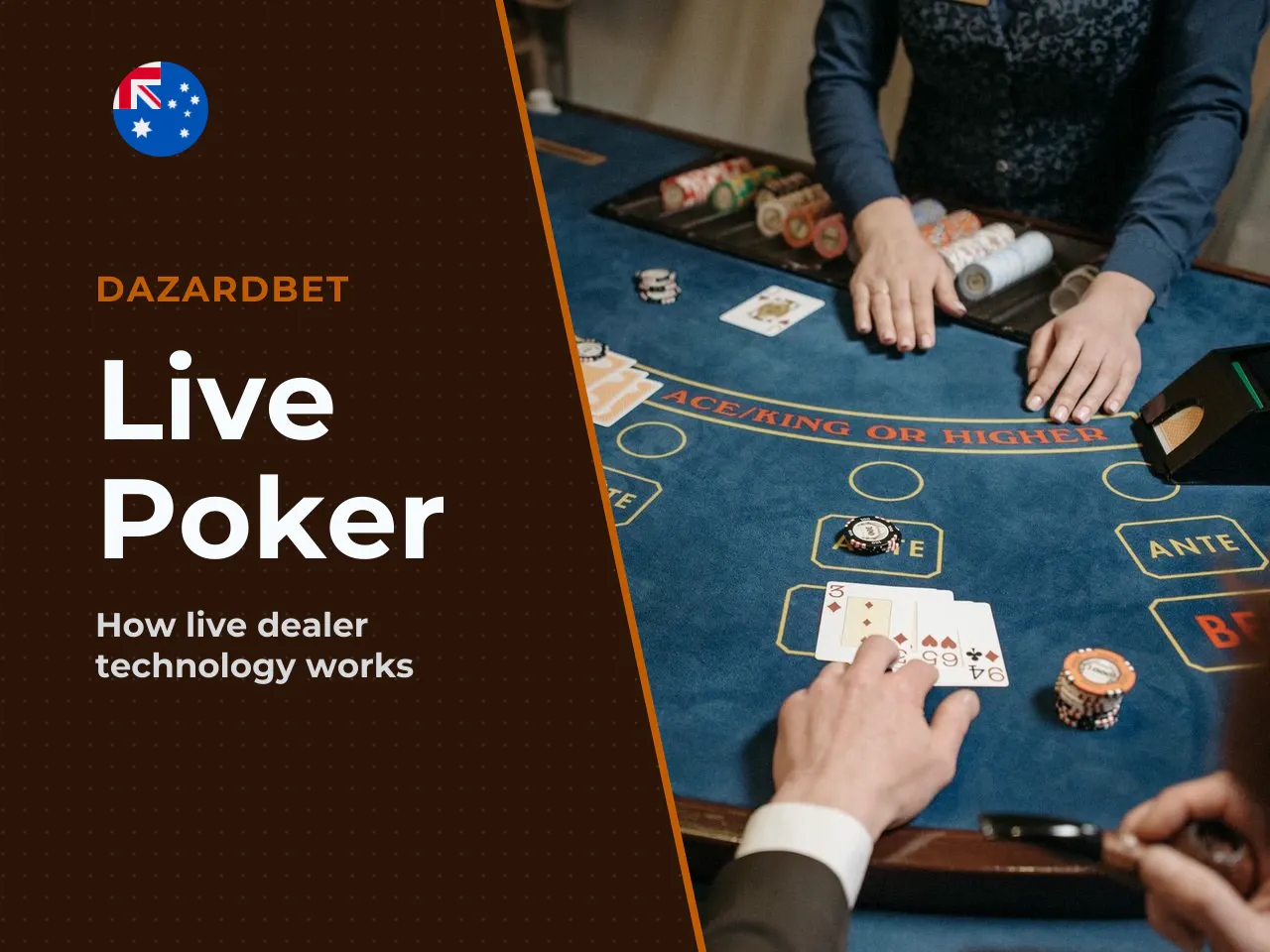
  1. Game Control Unit (GCU). A hardware unit roughly the size of a book, mounted under every live table. The GCU encodes the high-resolution (up to 4K) video feed in real time and synchronises it with the game server. Without it, dealers and players would face latency that makes timed decisions unworkable.
  2. Optical Character Recognition (OCR). Specialised cameras scan the physical card shoe, the table surface and the results of dice or wheels, then convert those physical elements (suit, rank, position) into digital data instantly. That data drives the player's on-screen interface within fractions of a second.

Studios are purpose-built: multiple 4K cameras, broadcast lighting, professional dealers and pit supervision. The commercial appeal is trust and sociability. A player who distrusts RNG output can watch the cards leave the shoe, and chat functions turn a solitary activity into a shared one. The risk profile, however, is the same as any house-banked game: fixed edge, fast rounds, continuous availability.

What to check before choosing a poker live casino

Live tables look reassuring, so the checks matter more, not less. Before you commit a cent, look at the available games and table limits during Australian evening hours, the minimum stake per hand, the paytable for each side bet, and whether the studio provider is named at all. Then check the boring parts: deposits, withdrawals, verification timing and whether the mobile client streams reliably on a phone connection. If the lobby hides limits until after registration, that is a signal in itself.

Format comparison matrix

ParameterPoker Demo (free play)P2P Poker GameCasino Poker (RNG)Live Dealer Poker
OpponentsOther free-play users / botsOther real playersThe houseThe house, via a human dealer
Card determinationRNG, virtual chipsCertified RNGCertified RNGPhysical cards plus OCR
MonetisationChip packs, subscriptionsRake / tournament feeHouse edgeHouse edge plus studio costs
Hand speedFast, no financial frictionModerate; fast-fold formats accelerate itVery fastSlower, paced by the dealer
Stake rangeNone (virtual only)Micro to nosebleedFixed table minimums and maximumsUsually higher minimums
Social interactionChat, clubsHigh, table dynamics matterMinimalHigh, dealer and chat
Primary purposeLearning, socialisingSkill competitionHouse-banked entertainmentImmersive house-banked play
Risk profileNo financial risk; normalisation risk flagged by regulatorsSkill-dependent; rake drag; multi-tabling exposureFixed negative EVFixed negative EV, longer sessions

Poker rules and formats

Texas Hold'em street by street. Each

Texas Hold'em: street by street

Each player receives two private hole cards. Five community cards are dealt across three stages.

  1. Pre-flop. Small blind and big blind are posted. Two hole cards go to each player. Action starts with the player to the left of the big blind and moves clockwise.
  2. Flop. Three community cards are exposed; a betting round follows.
  3. Turn. One further community card; another betting round.
  4. River. The final community card; the last betting round.
  5. Showdown. Remaining players table their cards. The best five-card hand from any combination of two hole cards and five board cards wins.

Available actions: Check (no bet outstanding), Bet (open the action), Call (match the current bet), Raise (increase it), Fold (surrender the hand). A street closes when all active players have matched the largest bet, or when everyone else has folded.

Omaha and Omaha Hi-Lo. Omaha PLO

Omaha and Omaha Hi-Lo

Omaha (PLO). Four hole cards each, and the final hand must use exactly two hole cards plus exactly three board cards. That constraint is the single most common source of beginner error: four cards do not mean «any two of the seven».

Because everyone holds four cards, average showdown hand strength rises sharply. Top pair is rarely a hand worth committing to. Nut-flush and nut-straight awareness, plus blocker value, matter far more than in Hold'em poker. Variance is materially higher, which flows directly into bankroll requirements.

Omaha Hi-Lo (Hi/Lo split). The pot is split between the best high hand and the best qualifying low hand. Where no low qualifies, the high hand takes the whole pot, so a single board can produce two winners. Fixed-limit versions are still common.

Beyond standard PLO, larger poker rooms run PLO5 and PLO6 (five or six hole cards), which increase action and variance again. Traffic in these games is thinner and often concentrated in European rather than Australian evening hours.

Short Deck 6 Hold'em . All

Short Deck (6+ Hold'em)

All 2s, 3s, 4s and 5s are stripped from the deck, leaving 36 cards. Betting structure and street order match Hold'em, but hand ranking changes because the probabilities change:

  • A flush beats a full house. With only 36 cards and eight cards per suit, flushes become rarer than full houses. This is the correction most new Short Deck players need. The common assumption that a full house always beats a flush is simply wrong in this variant.
  • Under some house rules, trips beat a straight, although that variation is gradually being phased out. Always read the table rules before sitting.
  • The Ace plays both high and as the low card of the smallest straight: A-6-7-8-9.

Short Deck attracts high-stakes and action-oriented players precisely because premium hands collide more often. Equities run closer together, which means bigger pots and higher variance per big blind risked.

Seven-Card Stud

  • Hole cards: up to seven per player (three face-down, four face-up)
  • Community cards: none

Because there is no shared board, Stud is a memory and deduction game. Tracking opponents' exposed door cards, and remembering the cards that were folded, is how you compute live outs accurately. It is one of the rarer offerings online. Many sites do not list it at all, and where it runs, peak activity usually falls in awkward hours for Australian time zones, typically during major online series.

Caribbean Stud Poker

A house-banked game. Player and dealer each receive five cards, with one dealer card exposed.

  • You post an Ante, look at your hand, then either Fold or make a Call bet of twice the Ante.
  • Dealer qualification: the dealer must hold Ace-King or better. If the dealer fails to qualify, the Call bet is returned and the Ante pays 1:1. (The frequently repeated claim that the dealer needs a pair of queens is incorrect.)
  • Paytables scale from even money for a pair up to 100:1 for a royal flush, with progressive jackpot pools that have exceeded $1,500,000 on some networks.

3 Card Poker

Three cards to the player, three to the dealer. Betting revolves around three positions: Ante, Play (made after seeing your cards) and Pair Plus, a standalone bet on your own hand strength that pays regardless of the dealer's holding. Simple, fast, and firmly house-banked.

Double Board Bomb Pots

An exotic cash-game format popularised by CoinPoker. Every player at the table posts a forced ante of 1–3 big blinds, pre-flop betting is skipped entirely, and the dealer immediately spreads two independent flops. Play then proceeds across both boards simultaneously, with the pot split between the two board winners. Pots are enormous relative to blinds, and equity calculations become genuinely difficult. That is exactly why recreational players enjoy it, and why bankroll requirements should be treated as higher than for standard cash games.

Zone Poker and fast-fold formats

Fast-fold pools (Zone Poker at Ignition, and equivalents elsewhere) move you instantly to a new table and a new hand the moment you fold. Hands per hour can triple. Strategically, that compresses your sample and speeds up learning. From a harm-minimisation point of view, it removes the natural cooling-off gaps between hands, which is worth acknowledging honestly.

Cash games versus tournaments structural implications

Cash games versus tournaments: structural implications for risk and behaviour

Cash games. Blinds are fixed for the life of the session. You may sit down and stand up at will, and top up your stack between hands to the table's full buy-in. Chips represent money at face value. Regular players grind deep-stacked, range-based poker: pre-flop selection by position, thin value betting, bluff-catching at the correct frequency, and multi-tabling to lift hands per hour. Because stacks reload, a losing session has no natural stopping point. The only stopping mechanism is a limit you set yourself.

Tournaments. A fixed buy-in produces a fixed maximum loss per entry (unless re-entry or rebuys are available), rising blinds force action, and payouts are top-heavy. Skills shift towards ICM-aware decisions, stack-size play and bubble dynamics.

It is widely asserted that games allowing rapid, repeated betting, with high variance and limited cooling-off periods, are more likely to contribute to harm among vulnerable players. We could not match this specific claim to a primary Australian study within our verification window, so we present it as a structural hypothesis consistent with the NSW harm findings above, not as a measured result. What can be said with confidence, from the AIFS and NSW data, is that harm concentrates among higher-intensity players. And cash games with unlimited top-ups are the highest-intensity poker product available.

Tournament formats compared

FormatStart conditionFieldDistinguishing mechanicPrize
MTTScheduled clockMultiple tables, large fieldTables condense as players bustCash, top-heavy by finish
Sit & GoWhen seats fillUsually single tableNo fixed start timeCash, typically top 2–3
PKO / KnockoutScheduledMulti-tablePart of each bounty paid instantly; remainder carried on your headBounties plus regular prize pool
SatelliteScheduled or SNG-styleVariesAwards entries, not cashSeats or tickets to a target event
FreezeoutScheduledVariesNo re-entry or rebuysCash
Re-entryScheduledVariesAdditional entries permitted in a defined windowCash
Guaranteed (GTD)ScheduledVariesPrize pool floor is guaranteed, overlay possibleCash, minimum pool advertised
Absence of recent Australian empirical studies

Absence of recent Australian empirical studies on poker rules and formats

Australian research quantifies gambling harm well at product-category level, but poker-specific prevalence work is thin and dated. Older research, published before our 2023 cut-off, has been cited as showing that regular poker players report problem gambling rates several times, and in some reports up to ten times, the national adult average. We flag this as time-expired evidence. The figure sits outside the 2023–2026 verification window used throughout this guide, it predates fast-fold formats, crypto rails and the current offshore market structure, and it should not be quoted as a current Australian statistic. Updated, poker-specific Australian prevalence data is genuinely needed.

Poker strategy fundamentals and bankroll management

Beginner poker strategy position, starting hands

Beginner poker strategy: position, starting hands and reads

  • Position is the cheapest edge in poker. Acting last on every post-flop street gives you information no amount of hand-reading skill can replace. Open a narrow range from early position and widen progressively towards the button.
  • Tight-aggressive (TAG) is the correct default. Fold most hands. When you enter a pot, do it with initiative: raise rather than limp, bet rather than check-call. Beginners lose far more money playing too many hands passively than playing too few.
  • Read tendencies, not tells. Online, «reading opponents» means tracking frequencies. Does this player fold to a flop continuation bet? Do they three-bet pre-flop? Do they check-raise? Two or three observed tendencies are worth more than a hundred hands of guesswork.
  • Understand pot odds and expected value. If a call costs $20 to win a $100 pot, you need roughly 17% equity to break even. Every decision is that comparison, repeated.

Bankroll standards for cash games and tournaments

No regulator or standards body sets poker bankroll rules. These are industry conventions derived from variance modelling, and we present them as exactly that.

FormatConventional minimumConservativeWhy
No-Limit Hold'em cash20–30 buy-ins40–50 buy-insModerate variance; deep-stack pots can vanish in one hand
PLO / PLO5 / PLO6 cash40 buy-ins75–100 buy-insEquities run close; swings are far larger
Short Deck cash50 buy-ins100 buy-insConstant premium-hand collisions
Single-table SNG50 buy-ins100 buy-insLow field size, moderate variance
MTT (small field)100 buy-ins200 buy-insTop-heavy payouts, long downswings
MTT (large field / PKO)200 buy-ins300+ buy-insCashing frequency below 15% is normal

Two operational rules make the table meaningful. Keep the bankroll physically separate from household money, and set a session stop-loss in buy-ins before you sit down, not after you are stuck.

⚠️ Variance warning. No poker strategy guarantees profit. Outcomes are governed by probability and variance, and a positive long-run edge can still produce months of losses. Rake and house edge reduce net expected value in every format. Set deposit, loss and time limits in advance, treat every stake as money you can afford to lose, and never chase losses by moving up in stakes. If gambling is affecting your finances, work, relationships or mental health, contact the National Gambling Helpline on 1800 858 858 (24/7, free, confidential).

Choosing poker sites and reading the offer

Legal disclaimer and responsible gambling warning

This information is general in nature and does not constitute legal advice. Real-money online poker is prohibited from being offered to Australian users under the Interactive Gambling Act 2001. Offshore sites accepting Australian players operate outside Australian consumer protection, dispute-resolution and self-exclusion frameworks, and may be blocked by ACMA at any time, potentially affecting access to account balances. Check the legal gambling age and the availability of real money games in your own state or territory before you act. If you are experiencing problems with gambling, contact the National Gambling Helpline on 1800 858 858. Gambling is restricted to adults aged 18 and over.

Legal constraints on online poker sites

Any poker site that offers real money poker or casino poker to customers physically present in Australia is, by definition, operating illegally. Readers who want the wider commercial and regulatory picture can review how the iGaming market in Australia is structured across licensed and unlicensed operators.

Because these operators cannot be licensed in Australia, they hold offshore licences, most commonly from the Malta Gaming Authority, Curaçao Gaming Authority or the Anjouan Offshore Finance Authority / Anjouan Gaming Board. Supervisory intensity varies enormously between those regimes. A Curaçao or Anjouan licence tells you a corporate entity exists and has agreed to certain conditions. It does not give an Australian player an enforceable route to compensation.

So when a site markets itself as the «best online poker» option for Australians, ask what that claim rests on. We publish the comparison below as market analysis, so readers understand what is being advertised to them and on what basis, not as a recommendation to play.

How offshore poker rooms compare on traffic in AEST, ACST and AWST

Player traffic during Australian evening hours (roughly 17:00 to 20:00 across AEST, ACST and AWST) determines whether cash tables actually run and whether tournaments hit their guarantees. Figures below reflect observed peak-hour concentrations reported for each network.

Poker roomPeak AU traffic (17:00–20:00)Game typesMTT formatsSignature formatRakeback / loyaltyAdvertised welcome offer
CoinPoker5,000+ playersHold'em, PLO, PLO5, PLO6, 6+Standard, Freezeout, Re-entry, Satellite, KO, PKODouble Board Bomb Pots15% plus CoinRewards150% up to $2,000 (AU$2,800)
Ignition Poker3,500+ playersHold'em, PLO, FLOStandard, Freezeout, Re-entry, SatelliteZone Poker (fast-fold), anonymous tablesIgnition Rewards150% up to $1,500 (AU$2,100)
BCPoker3,000+ playersHold'em, PLO, 6+Standard, Freezeout, Re-entry, Satellite, All-in or FoldAll-in or Fold Sit & Go10%–50%10% boost up to $200 (AU$280)
SportsBetting2,500+ playersHold'em, PLO, StudStandard, Freezeout, Re-entry, Satellite, KO, PKOOpen Face Chinese (Pineapple)VIP tiers100% up to $1,000 (AU$1,400)
Full House Crypto2,000+ playersHold'em, PLO, PLO5, PLO6, 6+Standard, Freezeout, Re-entry, Satellite$200K GTD freeroll seriesUp to 20% for VIPs250% up to $2,000 (AU$2,800) plus 20% instant cash

Reading the table properly: traffic figures are network-wide snapshots, not Australian-only counts, and headline bonuses are release-based. They convert to cash gradually as you generate rake, not on deposit. A 250% «bonus» that requires tens of thousands of hands to clear is a rakeback scheme with a marketing headline attached.

Available games, table stakes and player base

Traffic is only half the question. The other half is whether the games you want are running when you can actually play. Check the number of active tables at your stake, not just total players online. Check whether cash games and tournaments both have depth, or whether the lobby empties after the nightly major. Micro-stakes Hold'em usually runs somewhere, but PLO5, Short Deck and Stud can be dead for hours at a time in Australian evenings.

Software, mobile apps and customer service

Software, mobile apps and customer service standards

There is no poker-specific technical standard governing client software, table interfaces or RNG presentation. Requirements are set operator by operator. Two general standards are nonetheless useful benchmarks when assessing a platform:

  • Accessibility. WCAG 2.2 (W3C, 2023) requires interfaces to be perceivable, operable, understandable and robust. On mobile, that translates into readable bet sliders, reachable action buttons and functional screen-reader labelling.
  • Support. ISO 18295-1:2017 sets service requirements for customer contact centres, including monitored service levels and structured complaint handling. Ask whether live chat operates during Australian evening hours, whether there is a written complaints escalation path, and whether the licensing body offers any dispute mechanism at all.

A client checklist worth applying yourself. Does the mobile app support multi-tabling (four tables is a common ceiling)? Does the lobby show real-time table and tournament counts? Can you register for tournaments and manage the cashier from a phone? And if there is no app, does the browser version keep full functionality?

Bonuses, rakeback, freerolls and tournament tickets: what each is actually worth

Offer typeHow it is earnedTypical conditionsReal bankroll impact
Welcome / first deposit bonusPercentage match on first depositReleased incrementally against rake generated; expiry window, often 30–90 daysHigh headline, moderate real value; worthless if you cannot generate the required rake
Reload bonusMatch on subsequent depositsLower percentage, same release mechanicsSmall but reliable top-up for volume players
RakebackFixed percentage of rake returnedContinuous, sometimes tiered by volumeThe most transparent form of value; it directly reduces your cost per hand
Loyalty rewards and tiersCumulative rake or pointsMonthly or seasonal resets; higher tiers require sustained volumeMeaningful only for high-frequency players; a reset can wipe accrued status
FreerollsFree entry, sometimes qualification-basedHuge fields, tiny average return per entryNear-zero risk; useful for learning tournament structures
Tournament ticketsBonus, mission or satellite rewardFixed expiry; restricted to specified eventsReal value only if the target event suits your schedule and skill level
Free-play chip bonusesDaily login, streak rewardsVirtual chips only, no cash valueNo financial value; genuine training value

Always note the date you read the terms, because release rates and expiry windows change quietly. For free-play platforms, the equivalent offers are refreshingly transparent: Replay Poker's daily login bonus escalates from 500 to 2,500 chips by day five, with back-to-back streak rewards up to 100,000 chips and tournament tickets, while ClubGG's subscription provides ticket allocations for club events.

Deposits, withdrawals and payment options in the current regulatory context

Australia's payment rules changed materially in 2024. From 11 June 2024, licensed online wagering providers must not accept certain payment methods at all.

«The Interactive Gambling Amendment (Credit and Other Measures) Act 2023 prohibits the use of credit cards, credit-related products and digital currency for interactive wagering from 11 June 2024.» - Interactive Gambling Amendment (Credit and Other Measures) Act 2023. https://www.legislation.gov.au/Details/C2023A00118

Offshore poker sites are not bound by that Act. But that is a description of their unlawful status, not a feature. Reported processing times across the market are as follows.

Payout speed by method

Dazardbet heading-banner
  • Cryptocurrency (BTC, ETH, USDT):commonly credited to a wallet in 15–60 minutes; sites frequently quote «up to 4 hours» or «up to 24 hours» as a formal maximum.
  • Local rails (PayID, Apple Pay, Google Pay):1–24 hours, heavily dependent on the offshore acquiring bank; availability is far patchier than crypto.
  • Cards and bank transfers:3–5 business days, with a high decline rate for gambling-coded transactions.
  • Typical minimum deposits:AU$10 to AU$25.

Practical risks that headline speeds obscure: crypto transactions are irreversible, there is no chargeback route, exchange-rate movement between deposit and withdrawal is your risk, and KYC verification is frequently triggered at the point of first withdrawal rather than at sign-up.

Fact-checking methodology how to verify a

Fact-checking methodology: how to verify a site's terms yourself

Conditions change, and marketing pages lag behind legal documents. Apply a documentary discipline:

  1. Record the licence number, issuing authority and the date you checked it, then verify it in the regulator's public register rather than trusting a footer badge.
  2. Capture the version and effective date of the terms and conditions at the moment you register. Bonus release rates, maximum cash-out and expiry clauses all live there.
  3. Save the primary document, not a summary: the cashier page for limits and processing times, the bonus terms page for wagering, the responsible gambling page for limit tools.
  4. Where a marketing page and an official document conflict, the official document governs. Where two versions exist, the most recent effective edition applies.
  5. Re-verify before any material deposit increase. Terms are commonly amended with two weeks' notice, and continued use is treated as acceptance.
Ten-point pre-registration checklist. 1. Licence and

Ten-point pre-registration checklist

  1. Licence and regulator: number, issuing body, verifiable in a public register.
  2. Jurisdictional eligibility: do the operator's own terms permit Australian residents, and what does that imply legally?
  3. Game and format availability: are the disciplines and stakes you actually want running during Australian evening hours?
  4. Mobile experience: registration, cashier and tables fully functional on a small screen.
  5. Payment options: supported deposit and withdrawal rails, fees, currency conversion.
  6. Withdrawal terms: minimums, maximums, processing time, pending periods, reversal or cancellation rules.
  7. KYC and verification: what documents are required, and at what point in the customer journey.
  8. Bonus terms: wagering or release rate, eligible games, rake contribution, expiry, maximum cash-out.
  9. Responsible gambling tools: deposit and loss limits, session reminders, cooling-off, self-exclusion, and links to support services.
  10. RNG and integrity: independent testing certification, anti-collusion and bot-detection policy.

Step by step: from account creation to withdrawal

1
Choose your format honestly. If your goal is learning, a free-play platform such as Replay Poker or ClubGG delivers the same rules, structures and pressure-free repetition without financial or legal exposure.
2
Create the account. Use accurate personal details that match your identity documents. Mismatches are the single most common cause of blocked withdrawals. On ClubGG, registration happens inside the mobile app rather than in a browser.
3
Complete verification (KYC). Expect photo ID, proof of address and, where card payments are used, proof of payment ownership. Do this before you build a balance, not after.
4
Set your limits first. Deposit limit, loss limit, session reminder. Setting these at sign-up, before any winning or losing session colours your judgement, is the highest-value five minutes in the whole process.
5
Fund the account using a method you can also withdraw to. Confirm the minimum deposit, any fee, and whether the deposit qualifies for the offer you intend to claim.
6
Read the bonus terms before opting in. A bonus that locks funds or restricts withdrawal is a cost, not a gift.
7
Select a format and stake within your bankroll table. Start below the level you think you can beat. Yes, below.
8
Keep records. Date, format, stake, buy-ins, result. Every economic event should be documented as it occurs, with amount, date and method. It is the same discipline that underpins any auditable financial record, and the only way to know whether you are actually winning.
9
Withdraw regularly. Moving winnings out of the account is both a bankroll-management practice and a risk-management one.
Responsible gambling toolkit

Responsible gambling toolkit

  • National Gambling Helpline: 1800 858 858 -free, confidential, 24 hours, every day.
  • BetStop -the National Self-Exclusion Register; one registration covers all licensed Australian wagering providers, for three months up to a lifetime. https://www.acma.gov.au/betstop-national-self-exclusion-register-review
  • GambleAware NSWand equivalent state services - counselling, financial counselling and family support. https://www.gambleaware.nsw.gov.au/research-and-resources/nsw-gambling-survey-2024
  • Gamblers Anonymous -peer support meetings across Australia, in person and online.
  • Operator tools -deposit limits, loss limits, session time reminders, reality checks, cooling-off periods and account closure. Set them at registration.
  • Age restriction -all gambling in Australia is restricted to persons aged 18 and over. Simulated gambling in video games is classified R18+.

Warning signs worth taking seriously: chasing losses by moving up in stakes, gambling with money set aside for bills, concealing session length or losses, playing to escape stress, and irritability when unable to play.

FAQ: online poker in Australia

Editorial note on sources and method: every statistic in this guide is drawn from Australian regulator publications, government reports or prevalence studies published between 2023 and 2026, and each is cited inline with its publisher and URL. Where a widely repeated industry claim could not be matched to a primary source inside that window, including the demo-to-real-money pathway argument and older poker-specific prevalence figures, we have said so explicitly rather than repeating it as fact. Gambling involves risk of financial loss. 18+.