Dazardbet

Mines: A Complete Research-Based Guide to the Grid Game, Its Maths, Its Providers and Its Risks

Last updated: May 2026 · Reviewed by: the iGaming analysis desk · 18+ only

Disclaimer: This guide is educational and analytical. It is not financial, legal or medical advice, and it is not an inducement to gamble. Gambling products carry a built-in house edge, and losses are the statistically expected outcome over time. If gambling is causing you or someone else harm in Australia, contact the National Gambling Helpline on 1800 858 858 (24/7), visit Gambling Help Online, or register with BetStop, the National Self-Exclusion Register.
Provider

Spribe

RTP

97%

Volatility

Player-adjustable

Min bet

0.01

Max win

5,148,297.00×

Mines A Complete Research-Based Guide to
Table of ContentCloseOpen
Key takeaways. - Mines is not

Key takeaways

  • Mines is not Minesweeper. There are no numeric hints and no deduction: you pick tiles blind, each safe pick lifts a multiplier, and you choose when to cash out. It is an instant-win, continuous-play casino format, not a logic puzzle.
  • The maths is fully knowable. On a 5×5 grid the fair multiplier for k safe picks with M mines is C(25,k) / C(25−M,k), scaled by the game's RTP. Every published Spribe multiplier we tested reproduces exactly at RTP = 97%.
  • RTP depends on the provider, not on the game name. Stake Originals ≈ 99%, Spribe ≈ 97%, Hacksaw Gaming ≈ 94%, TaDa Gaming advertises a 10,000× max win.
  • No strategy changes expected value. Because the paytable is a uniform scaling of fair odds, Paroli, Martingale, "10 Bets" and 1:1 flat betting all return the same expected loss per dollar staked. Only volatility changes.
  • There is no standalone "Mines APK". Mines runs as an HTML5/WebGL client (commonly PixiJS) inside a casino site, its PWA or its wrapped app. Files marketed as "mines download with real payouts" are either casino clients or unaffiliated simulators.
  • A mines demo is not neutral. Experimental evidence shows practice modes with inflated returns increase later real-money bet sizes, and warning pop-ups did not neutralise the effect.
  • Australian context matters. Australians lost more than $32 billion in 2023–24, roughly $1,521 per adult, and more than 70% of regular online bettors are experiencing or at risk of gambling harm.
Who this guide is for, and

Who this guide is for, and who should skip Mines

This is written for two kinds of reader. The first is checking a mines casino before a first deposit and wants the terms in plain English. The second already plays and wants the arithmetic behind the multiplier ladder, plus the restrictions nobody advertises.

Across the sections below we cover mechanics, the provider registry, mines demo versus real money, Australian legality, RTP and strategy limits, mobile and download claims, fairness verification, harm data, a pre-deposit checklist and a comparison with Minesweeper and similar instant formats.

You should probably skip Mines entirely if:

  • You are chasing a loss right now. Fast games are the worst possible tool for that.
  • You cannot state, in dollars, the amount you are prepared to lose in the next hour.
  • You are relying on a bonus balance and have not read the wagering contribution for instant games (it is often 0–10%).
  • You are in Australia and cannot confirm the operator is permitted to serve you. That one is not a preference. It is a legal and practical risk.

1. Mines in the Contemporary Online Gambling Ecosystem

Mines belongs to the family of "instant" casino games that emerged alongside crash titles such as Aviator, Plinko-style droppers, Dice and Tower. A round lasts seconds, the interface is minimal, the outcome is resolved by a server-side random draw, and the player's only real decision is when to stop. Mines fits squarely within this instant-win, continuous-play category, and that category behaves very differently from a draw-based lottery or a weekly sports bet.

«Participants described instant-win games as more 'pulling' because of easy access, immediate results and immersive design that encourages repeat spend.» - GambleAware, Qualitative Study on Lottery Players (UK, 2024)

That perception is not cosmetic. Speed

That perception is not cosmetic. Speed of resolution, ease of re-staking and the absence of a natural break point are precisely the structural features that gambling-harm research associates with escalation.

So Mines is not simply an abstract puzzle with hidden mines and safe cells. It is a monetised product distributed through the online casino ecosystem, bundled with deposit flows, bonus wagering requirements, autoplay and loss-chasing affordances.

The Australian backdrop is unusually stark. Australia records the highest per-capita gambling losses in the world.

«Australians lost more than $32 billion on gambling in 2023–24, approximately $1,521 per adult.» - Australian Government Response to the Online Gambling Inquiry (2024)

Any discussion of "the best mines strategy" that ignores this context is incomplete. The rest of this guide treats Mines as three things at once: a game with transparent mathematics, a commercial product that is regulated in some markets and unregulated in others, and a public-health risk object.

1.1 Provider registry: the same name, four different games

Most guides discuss "Mines" as if it were a single product. It is not. Graphics, grid size, mine range and return-to-player differ by studio, and those differences materially change your risk profile.

ProviderGridMine rangeRTP (as published)Max winNotable features
Stake Originals5×5 (25 tiles)1–24≈99% (house edge ≈1%)Uncapped by paytable structureProvably fair (server seed / client seed / nonce), instant bet, hotkeys
Spribe5×5 (25 tiles)1–24≈97%Determined by picksAuto-play, mines demo mode, one-click cash-out
Hacksaw Gaming3×3 to 9×9 (variable)1–80≈94%Grid-dependentGrid resizing, "Quick Picks"/instant-games placement
TaDa GamingFixed gridSelectableNot published in vendor sheet10,000×Jackpots, both-party seed verification, released 05/2023
Three practical consequences 1. The Mines

Three practical consequences:

  1. The "Mines RTP" question has no single answer. The widely quoted "RTP for Mines is 94%" is correct only for the Hacksaw title. On a 97% Spribe build, the same $100 of turnover carries roughly half the expected cost; on a 99% Stake Originals build, roughly one-sixth.
  2. Grid size changes the whole probability tree. Hacksaw's variable grid (up to 81 cells and up to 80 mines) produces multiplier ladders that are not comparable to a 5×5 board.
  3. Always verify inside the game's own help or paytable screen before you stake. Third-party guides are frequently wrong. See Appendix A, where we document a widely republished claim that Stake's Mines uses a "12×12 minefield". It does not. It is 5×5, 25 tiles.

2. How Mines Actually Works

2.1 Grid, Mines, Safe Cells and Difficulty

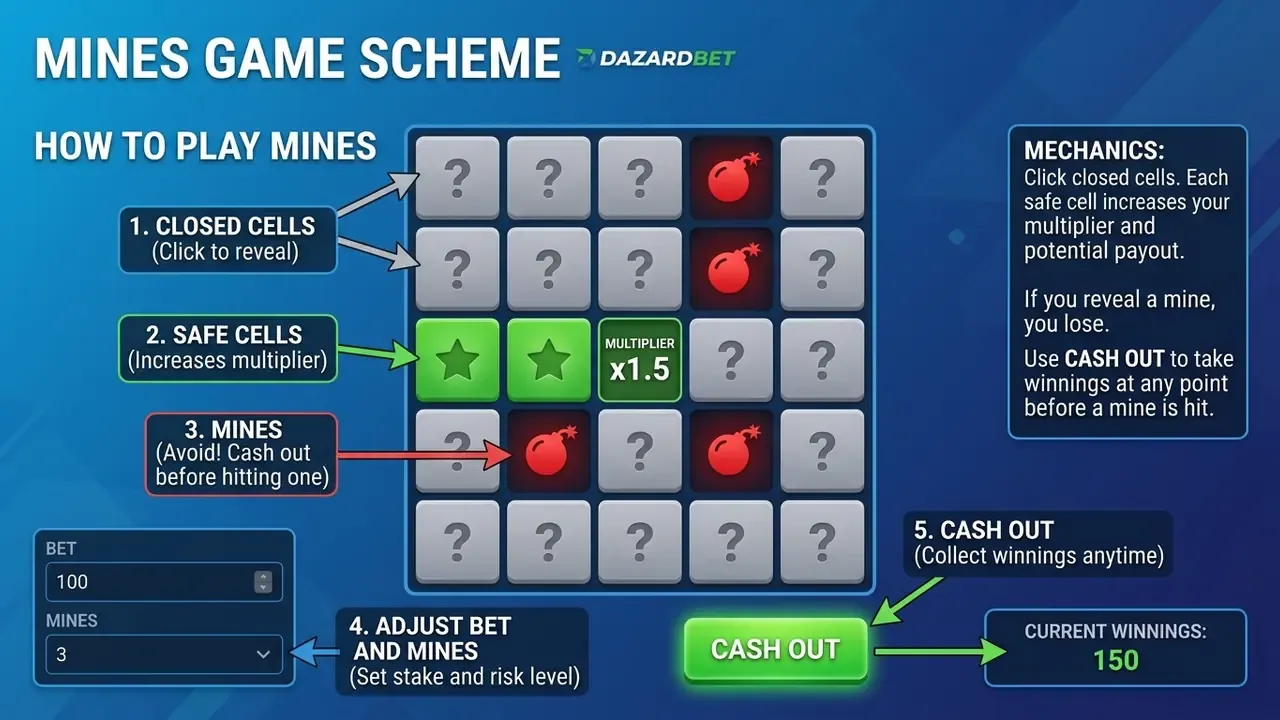
The canonical build is a 5×5 grid of 25 concealed tiles. Before the round you select a stake and the number of mines (1–24). Mine positions are drawn at random for that round only. There are no hints, no adjacency numbers and no information carried over from previous rounds. Each tile you open is either a gem (multiplier rises, you may continue or cash out) or a mine (round ends, stake lost).

Difficulty is therefore a slider, not a skill ceiling, and the slider directly sets volatility. That matters, because volatility is one of the structural characteristics most strongly linked to harm.

«Structural characteristics, including stake size, volatility and speed of play, are key drivers of harm indicators such as binge gambling and unaffordable spending.» - UK Government, Online Slots Stake Limit Impact Assessment (2024)

The interface is deliberately agentic. You touch the tiles. You "choose the path". That design feature reliably manufactures an illusion of control, and players start to believe their route through the grid, corners, diagonals, a "lucky" pattern, can shift the odds. It cannot. Mine placement is fixed at round generation and is independent of the order in which you reveal cells.

«Experimental reviews of simulated gambling show that illusions of control are powerful drivers of excessive play and risk-taking.» - Hing et al., Integrative Review on the Convergence of Simulated and Monetary Gambling (2025)

The probability table competitors get wrong

Below is the corrected model for a 5×5 board. The multiplier column uses a 97% RTP build (Spribe-equivalent); multiply by 1.0206 for a 99% build, or by 0.9691 for a 94% build.

MinesSafe cellsP(1st pick safe)Multiplier after 1 pickP(2nd pick safe | 1st safe)Cumulative P(2 safe picks)Multiplier after 2 picks
124 / 2596.0%1.01×95.8% (23/24)92.0%1.05×
322 / 2588.0%1.10×87.5% (21/24)77.0%1.26×
520 / 2580.0%1.21×79.2% (19/24)63.3%1.53×
1015 / 2560.0%1.62×58.3% (14/24)35.0%2.77×
1510 / 2540.0%2.43×37.5% (9/24)15.0%6.47×
205 / 2520.0%4.85×16.7% (4/24)3.33%29.10×
241 / 254.0%24.25×---
Why every additional pick is riskier

Why every additional pick is riskier than the last. After a safe reveal, the mine count is unchanged, but the pool of unknown tiles has shrunk by one. With 5 mines, your first pick is 80% safe; your fifth is 19/21 ≈ 76.2%; your tenth is 14/16 = 87.5%… no, let me be precise: after nine safe picks, 16 tiles remain, of which 5 are mines, so the next pick is 11/16 = 68.8% safe. The conditional hazard rises monotonically. That is why "one more tile" is the single most expensive habit in Mines.

The formula, in full. The fair (zero-edge) multiplier for k safe picks with M mines on N cells is:

Fair multiplier = C(N, k) / C(N − M, k)
Paid multiplier = Fair multiplier × RTP

Worked check on published Spribe values: 13 mines / 1 pick → C(25,1)/C(12,1) = 2.0833 × 0.97 = 2.02× ✔ · 8 mines / 2 picks → C(25,2)/C(17,2) = 2.2059 × 0.97 = 2.14× ✔ · 6 mines / 3 picks → C(25,3)/C(19,3) = 2.3736 × 0.97 = 2.30× ✔ · 4 mines / 4 picks → C(25,4)/C(21,4) = 2.1137 × 0.97 = 2.05× ✔.

Four independent matches confirm both the formula and a 97% RTP on that build. It also means you can reverse-engineer any Mines RTP yourself in under a minute, which is a far better fairness test than any "hot tile" theory.

2.2 Stake, Multipliers and Cash-Out Decisions

2.2 Stake, Multipliers and Cash-Out Decisions

Three levers exist: stake size, mine count and the cash-out point. Stake sets exposure per round. Mine count sets the shape of the multiplier ladder. Cash-out timing sets where on that ladder you stop.

The interface reflects this. A typical Mines screen contains the grid of concealed cells (centre), a bet amount field with quick +/– or ½/2× controls (left or bottom panel), a mines selector (slider or dropdown, 1–24), a Bet / Pick a tile primary button, a live current win / current multiplier indicator, a Cash Out button that activates only after the first safe reveal, an auto-play tab, and, on provably fair builds, a Fairness / Seed panel.

Cash-out is framed as a skill decision, which is exactly why it is psychologically loaded. Deciding whether to bank 1.53× or push for 2.77× is a choice under uncertainty, and choices under uncertainty are systematically distorted by loss aversion, regret anticipation and the sunk-cost fallacy. (Note: the specific behavioural-economics experiments underpinning this point sit outside the evidence base compiled for this article. The closest sourced statement is the finding below on illusions of control and design-induced bias in gambling products. Additional primary data required.)

«Repeated gambling produces changes in brain regions associated with learning, stress management and reward processing, similar to those seen in substance dependence.» - Wagering Advertising Reform Impact Analysis, Office of Impact Analysis (2026)

The commercial reality behind the cash-out button is worth stating plainly. Instant-play products do not earn evenly across a player base:

«Around 1% of accounts contribute more than 40% of total online slots revenue, indicating concentration of harm within a small, vulnerable group.» - UK Government, Online Slots Stake Limit Impact Assessment (2024)

And Australian wagering turnover has grown steeply alongside digital distribution:

«Wagering losses rose from $3 billion in 2010–11 to $8.4 billion, about 26% of all gambling losses, in 2023–24.» - Wagering Advertising Reform Impact Analysis, Office of Impact Analysis (2026)

3. Mines Demo, Social Casinos and Simulated Gambling

3.1 Definitions and Regulatory Position of Social Casinos and Simulated Gambling

A mines demo (free-play) round uses a simulated balance and no wager. A social casino Mines round uses virtual coins that may be purchasable but are not redeemable for money. A mines real money round settles in cash or a cash-equivalent balance.

Crucially, social casinos are not regulated under Australia's Interactive Gambling Act 2001, because no prize of monetary value is paid out.

«ACMA defines social casinos as online casino-style games that users play for various reasons, but not to win real money.» - ACMA, Market Overview of Social Casinos in Australia and Overseas (2023)

That regulatory gap is why mines free clones are easy to reach for Australian users, including, in practice, minors, while real-money Mines offered by an offshore operator to Australians is a prohibited service.

3.2 Experimental Evidence on Demo Modes and Risk-Taking

Free play is usually marketed as harm-reducing: "test the strategy first, risk nothing". The experimental literature complicates that story. In a randomised design with 128 participants across four conditions (inflated-RTP practice, inflated practice plus pop-up warnings, standard practice, no practice), those exposed to the inflated demo placed significantly higher bets in real play than participants in the standard-practice and no-practice groups.

«Participants exposed to a demo mode with inflated RTP placed significantly higher bets in real-money play than the control group.» - Gainsbury et al., cited in Hing et al., Integrative Review (2025)

The attempted fix did not work:

«Adding pop-up warning messages during inflated practice did not meaningfully dampen the increase in betting when players moved to real money.» - Gainsbury et al., cited in Hing et al., Integrative Review (2025)

Applied to Mines: if a mines free demo credits wins more generously than the live paytable, or simply hands you an early lucky run on 20 mines, the calibration you carry into the cash game is wrong. A banner saying "results in demo mode may differ" will not correct it. The defensible way to play mines in demo is narrow: learn the controls, verify the multiplier ladder against the formula in §2.1, then stop.

3.3 What actually separates a demo

3.3 What actually separates a demo round from real money

Same grid. Same mine slider. Different consequences. Four differences are worth holding in mind before you switch modes:

  • Balance. A mines demo credits a simulated bankroll that resets. A real-money stake leaves your wallet at the moment you press Bet.
  • Calibration. Demo builds are not always tuned to the live RTP, and few operators state this openly.
  • Emotional load. Cash-out at 2.77× feels trivial with play credits and hard with rent money. That gap is the point of the demo, and also its trap.
  • Terms. Bonus wagering, max-bet caps and withdrawal rules only exist in the real-money version, and they are where most disputes start.

3.4 Longitudinal and Cross-Sectional Evidence

The transition risk from simulated to monetary gambling is measurable.

«Adolescents who played simulated gambling games had around a 40-percentage-point higher probability of engaging in monetary gambling as young adults.» - Australian Gambling Research Centre / AIFS, Gambling with their future: teenage gamers and pathways to gambling (2024)

«Past-month social casino game play increased the odds of gambling disorder by about 2.5 times (95% CI 1.54–4.02) compared with non-players.» - Hing et al., Not all games are created equal (2024), n = 826, logistic regression

Mines is one of the easiest formats to clone as a free browser game. No licensing, no assets, no payments integration. That makes it a high-volume entry point into this pathway.

4. Legality, Regulation and Enforcement in Australia

4.1 Licensing, Legality and Enforcement

Under the Interactive Gambling Act 2001, offering online casino games, including Mines, to Australians is prohibited. Sports and race wagering with a licensed Australian operator is permitted. Online casino product is not. Enforcement is active rather than theoretical:

«Between October and December 2023, ACMA recorded 57 breaches and requested the blocking of 58 websites offering illegal gambling to Australians.» - ACMA, Enforcement and Disruption Report, October–December 2023

Players using such sites lack the safeguards attached to licensed Australian-facing services and licensed casino services in comparable jurisdictions: no local dispute resolution, no enforceable deposit-limit or self-exclusion obligation, no guarantee that advertised RTP has been independently certified, and no recourse if withdrawals freeze mid-KYC. Domain blocking adds one more wrinkle. A site can disappear between your deposit and your withdrawal request.

4.2 National Data on Gambling Participation and Harms

«A nationally representative 2024 survey of more than 1,700 adults found that 60.3% of Australian adults had gambled in the past 12 months.» - ANU, National Survey of Gambling Participation in Australia (2024)

Participation at that scale means small structural changes to fast products propagate widely. Mines-type games are cheap to deploy, trivially localisable, and sit adjacent to sports betting apps in the same wallets.

4.3 Policy Responses: Public-Health Framing and Consumer Protection

Australian policy has shifted from an individual-responsibility framing towards a public-health framing. Concrete measures include a ban on credit cards and other credit-related products for online wagering, in force from June 2024, the BetStop national self-exclusion register, and mandatory customer pre-verification.

«From September 2024, mandatory minimum classifications took effect for games with simulated gambling: R18+ for simulated gambling and M for paid loot boxes.» - Australian Government Response to the Online Gambling Inquiry (2024)

For Mines specifically, the R18+ classification of simulated gambling is the most directly relevant reform. It recognises that a free Mines clone is not a neutral arcade toy.

5. Maths, RTP and the Mines Strategy Reality Check

5.1 RTP and House Edge in Mines-Type Games

RTP is the long-run proportion of turnover returned as winnings. The house edge is the remainder. At 97% RTP, every $1 staked has an expected cost of 3 cents, per round. Mines rounds can complete in three seconds. A player averaging 300 rounds an hour at $2 turns over $600 and carries an expected loss of $18 an hour, before any variance.

«Even a relatively small house edge can produce substantial cumulative losses when combined with high frequency of play, long sessions and larger stakes.» - University of Bristol, Cross-Disciplinary Synthesis of Gambling Harms

Updated on transparency practice: some operators publish a single overall RTP figure in the game's help screen, while others present only the multiplier ladder for each mine count and pick depth. Where a headline RTP is absent, derive it yourself: divide the displayed multiplier by the fair multiplier from §2.1. If displayed ÷ fair lands at 0.97, the build is 97%. If it lands at 0.94, it is 94%. Treat any game that will not let you reconstruct this as unverifiable.

5.2 Illusions of Control and Design-Induced

5.2 Illusions of Control and Design-Induced Biases

Mines is engineered to feel like a skill game. Four design features drive that feeling: tile agency (you choose), incremental feedback (each gem is a small reward event), a voluntary stop (cash-out reads as judgement), and a visible mine-count slider (risk feels "managed"). None of them alters the draw.

The three most common false beliefs, corrected:

  • "Corners are safer." No. Mine placement is uniform across tiles.
  • "After three mine hits, the fourth round is due for a win." No. Rounds are independent, and every layout is generated fresh.
  • "Fewer mines is a safer strategy." Safer per pick, identical in expected value. One mine and one pick returns 96% × 1.01× = 0.97, exactly the same expectation as 20 mines and one pick (20% × 4.85× = 0.97).
5.3 Low-Risk and High-Risk Mines Approaches

5.3 Low-Risk and High-Risk Mines Approaches

  • Low-risk shape:1–3 mines, one or two picks, cash out immediately. High hit rate (77–96%), tiny multipliers, long sessions, slow bleed.
  • Balanced shape:5–10 mines, two or three picks. Hit rates in the 35–63% band, multipliers 1.5× to 2.8×.
  • High-risk shape:15–24 mines, one or two picks. Hit rates 4–40%, multipliers 2.4× to 24×. Long dry spells are normal, not a malfunction.
ApproachMinesTypical picksHit rateMultiplier bandUsual cash-out pointWhat it feels like
Low risk1–31–277–96%1.01×–1.26×Immediately after the first or second gemFrequent small wins, quiet erosion of the bankroll
Balanced5–102–335–63%1.53×–2.77×Two or three tiles inReadable swings, moderate session length
High risk15–241–24–40%2.43×–29.10×The first safe tile, usuallyLong droughts, occasional spikes, fast bankroll damage

Read that table as a volatility map, not a profit map. The expected cost per dollar staked is the same in all three rows. What changes is how long your bankroll survives and how the session feels while it happens.

«Research on gambling harms consistently shows that higher stakes, greater volatility and faster event frequency increase the likelihood and severity of harm.» - University of Bristol, Cross-Disciplinary Synthesis of Gambling Harms; UK Government, Online Slots Stake Limit Impact Assessment (2024)

5.4 Betting systems: what they do and what they cannot do

Because Mines paytables are a uniform scaling of fair odds, every pick pattern and every staking pattern returns the same expected value per dollar staked. Systems redistribute variance. They do not create edge. With that stated, here is how the four systems actually run, with the arithmetic done properly.

5.4.1 The 1:1 flat strategy (lowest volatility)

Set 1 mine, open exactly one tile, cash out at 1.01×. Win probability 96%. Profit per win at a $1 stake: $0.01. Expected frequency of a loss: once every 25 picks. So one loss (−$1.00) erases 100 wins (+$1.00). The system feels like winning 24 times out of 25 while quietly losing 3% of turnover. It is the clearest demonstration in the game that hit rate and profitability are different things.

5.4.2 Paroli (positive progression), corrected 20-round simulation

Rules: base unit $1. Configuration 8 mines, 2 picks, cash out at 2.14× (win probability 45.33%). Double the stake after a win, up to three consecutive wins. Reset to $1 after any loss and after the third win.

Note: guides that pair a 2.14× target with a single mine are mathematically impossible. With one mine, multipliers follow 25/(25−k) × RTP and never land on 2.14×. Use 8 mines / 2 picks.

#StakeResultP/LRunning total
1$1Win 2.14×+$1.14+$1.14
2$2Loss−$2.00−$0.86
3$1Loss−$1.00−$1.86
4$1Win+$1.14−$0.72
5$2Win+$2.28+$1.56
6$4Loss−$4.00−$2.44
7$1Loss−$1.00−$3.44
8$1Loss−$1.00−$4.44
9$1Win+$1.14−$3.30
10$2Win+$2.28−$1.02
11$4Win+$4.56+$3.54
12$1Loss−$1.00+$2.54
13$1Win+$1.14+$3.68
14$2Loss−$2.00+$1.68
15$1Win+$1.14+$2.82
16$2Win+$2.28+$5.10
17$4Loss−$4.00+$1.10
18$1Loss−$1.00+$0.10
19$1Win+$1.14+$1.24
20$2Win+$2.28+$3.52

Total staked across the 20 rounds: $35. Expected value at 97% RTP: −$1.05. The sample finished +$3.52, a $4.57 swing above expectation from 20 rounds. That is the whole lesson: a winning Paroli session is evidence of variance, not of a working system. The known weakness is structural. Losing on the third step of the progression (the $4 bet) surrenders the accumulated run, and Mines produces those three-win streaks only about 9.3% of the time (0.4533³).

5.4.3 The "10 Bets" system (four series, 13 → 8 → 6 → 4 mines)

A notebook system for short, structured sessions. You play four series of 10 rounds. Each series has a fixed mine count, a fixed pick depth and a fixed cash-out target. After each round you write the next series' stake: −1 unit after a loss, +1 unit after a win (never below the table minimum).

SeriesMinesPicksCash-out targetHit rateEV check
11312.02×48.0%0.48 × 2.02 = 0.97
2822.14×45.3%0.453 × 2.14 = 0.97
3632.30×42.1%0.421 × 2.30 = 0.97
4442.05×47.3%0.473 × 2.05 = 0.97

(Some guides list the second target as 2.13×. The exact value at 97% RTP is 2.14×.)

A completed worksheet looks like this. The stake row for each series is generated by the results of the row above:

Mines / steps12345678910
13 / 1 step (2.02×)$1 L$1 W$1 W$1 L$1 W$1 W$1 W$1 L$1 W$1 L
8 / 2 steps (2.14×)$1 W$2 L$2 W$1 L$2 W$2 L$2 L$1 L$2 L$1 L
6 / 3 steps (2.30×)$2 W$1 W$3 W$1 W$3 W$1 L$1 L$1 L$1 L$1 L
4 / 4 steps (2.05×)$3 W$2 W$4 W$2 W$4 L$1 L$1 L$1 W$1 W$1 L
13 / 1 step (next cycle)$4$3$5$3$3$1$1$2$2$1

After the fourth series, return to 13 mines and continue. Stop after 10 to 12 completed lines regardless of result.

Mandatory caveat: this system reduces impulsive decision-making and caps stake escalation, but it does not change the mathematical advantage of the house. Over enough rounds the 3%, or 6% on a 94% build, is collected in full.

5.4.4 Martingale negative progression , the

5.4.4 Martingale (negative progression), the bankroll arithmetic

Double after every loss, reset after a win. Using the 13-mine / 1-pick / 2.02× configuration (48% win rate), a doubling ladder from $1 runs 1, 2, 4, 8, 16, 32, 64, 128, 256, 512, a cumulative $1,023 committed to recover a single $1 unit after ten straight losses. The probability of ten consecutive losses at a 52% loss rate is 0.52¹⁰ ≈ 0.145%, or roughly once every 692 sequences. At 300 rounds an hour, "once in 692" is not a remote event. It is a Tuesday.

Hard rules if you use it at all: bankroll ≥ 100× base unit (500× is more honest), check the table maximum before starting, because a hard cap converts Martingale into a guaranteed-loss machine at the ceiling, and pre-commit an absolute stop.

Fibonacci and D'Alembert are gentler variants of the same negative-progression logic and carry the same fundamental limitation.

6. Mines Mobile, Apps and the "Mines Download" Myth

6.1 Growth of Mobile Gambling in Australia

Mines is typically optimised for mobile play, with responsive interfaces that rescale the grid, stake field and mines slider to a phone screen. That is why mobile casino platforms are the dominant distribution channel for the format.

«Gambling through mobile devices is associated with continuous gambling that can lead to losses and harm at a faster rate than gambling in venues.» - ANU, National Survey of Gambling Participation in Australia (2024)

A phone removes every natural friction point: no travel, no closing time, no witnesses, no queue. In a three-second game, friction is the only brake that exists.

6.2 Browser, PWA or APK what

6.2 Browser, PWA or APK: what is actually being downloaded

There is no standalone Mines app from Spribe, Hacksaw, Stake Originals or TaDa in the Google Play Store or the Apple App Store. Mines online is an HTML5/WebGL client, commonly built on PixiJS, that loads inside a casino page via iframe. What you can install is one of three things:

  1. A browser session. Nothing installed. The canonical, lowest-risk delivery, and the way most people play mines on mobile.
  2. A PWA or WebView wrapper of a casino. The operator's own client. The Mines game inside it is the same web build.
  3. A third-party "Mines APK". Either an unaffiliated free simulator with no cash-out at all, or a repackaged wrapper of unknown provenance.

Guides that promise a "mines download with real payouts" and then concede in the next paragraph that "the app is not yet available as a standalone app" are describing category 3 while implying category 1. Treat that contradiction as a red flag about the whole page.

Safety checklist for mines mobile play

  • Install operator clients only from the operator's own verified domain or an official store listing. Never from a file-sharing mirror.
  • Sideloaded APKs bypass store review, and mobile-security guidance (OWASP Mobile Top 10, 2024) consistently ranks insecure data storage and weak session handling among the top risks in such builds.
  • Store policies (Apple App Store Review Guidelines; Google Play Payments policy) require in-app payment flows to run through approved mechanisms. Apps that route deposits through unexplained third-party pages sit outside those rules.
  • Use unique credentials and enable two-factor authentication where offered (NIST SP 800-63B).
  • Keep clients updated. Security fixes ship in point releases.
  • Verify the operator's licence details and whether it is permitted to serve your jurisdiction before the first deposit.

Connection requirements are modest, since Mines transmits small state payloads rather than video. Still, a dropped connection mid-round is the most common source of disputes. Check the game's disconnection policy in the help screen: reputable builds settle the round server-side and honour the state on reconnect.

  1. Provably Fair, RNG and How to Verify a Round Yourself

Two different fairness models exist, and they are not interchangeable.

Certified RNG. A licensed operator's game uses a random number generator tested by an accredited laboratory, with the RTP declared in the paytable. You verify it by reading the game's help and rules screen and the licensing footer, not by inference from your own results.

Provably fair. Crypto-native builds (Stake Originals, TaDa and others) let you reconstruct the round yourself. The scheme uses three inputs: a server seed (published as a hash before play, revealed later), a client seed (yours, editable), and a nonce (round counter). The mine layout is derived deterministically, typically via HMAC-SHA-256.

Step-by-step verification

1
Before you play, copy the hashed server seed from the Fairness panel and save it outside the site.
2
Set your own client seed. If you cannot edit it, the scheme is weaker.
3
Play the round and note the nonce.
4
Rotate or reveal the server seed, usually by rotating your client seed, which forces the unhashed server seed to be published.
5
Hash the revealed server seed with SHA-256 and confirm it matches the hash you saved in step 1. A mismatch means the layout was not committed in advance.
6
Recompute the layout: feed server seed, client seed and nonce into the provider's published HMAC-SHA-256 routine and derive the mine positions. Compare with what the grid actually showed.
7
Cross-check the paytable using displayed multiplier ÷ fair multiplier from §2.1 to confirm the RTP.
What provably fair does not mean. It proves the round was not tampered with after the fact. It does not remove the house edge, does not make the game +EV, and says nothing about whether the operator is licensed to serve Australian residents.

8. Harm Data: National Estimates, Demographics and Adolescents

8.1 National Estimates of Harm and Social Cost

Recent Australian analysis estimates the total cost of wagering in Australia in 2023 at $26.8 billion.

«The total social cost of wagering in Australia in 2023 is estimated at $26.8 billion, including $4.9 billion in psychological harm and $8.2 billion in health harm.» - Wagering Advertising Reform Impact Analysis, Office of Impact Analysis (2026)

These figures cover wagering rather than Mines specifically, but they establish the scale of externalities against which any fast, continuous online product must be assessed.

8.2 Demographic Patterns: Young Adults and Regular Online Bettors

«More than 70% of Australian adults who regularly bet online on sports or races are experiencing or at risk of experiencing gambling harm; the 18–34 group is most vulnerable.» - AIFS, cited in Wagering Advertising Reform Impact Analysis (2026)

This is the same demographic most exposed to crash and Mines-style products through streaming, social feeds and referral codes. Existing protections are not landing as designed. Regular bettors perceived harm-reduction tools such as activity statements, deposit limits and BetStop as insufficient or reactive.

«Many regular bettors see harm-reduction tools as inadequate or intended only for 'problem gamblers', not for themselves.» - National Gambling Trends Study (Australia, 2023)

8.3 Simulated Gambling and Harms Among Adolescents

Adolescents often do not perceive simulated gambling as "real gambling", viewing it instead as just part of gaming.

«Simulated gambling 'doesn't give off the gambling vibes'. It just feels like part of the game, which reduces young people's inclination to self-regulate.» - Hing et al., qualitative study on adolescent simulated gambling

Free Mines clones are a textbook case: cartoon gems, virtual credits, no age gate in practice, and a multiplier ladder identical to the cash version.

9. Practical Implications

9.1 Implications for Individual Mines Players

Australian responsible-gambling frameworks and public-health approaches recommend pre-committing how much you can afford to lose, before you even open the game.

«Australian responsible-gambling approaches recommend deciding in advance the amount you can afford to lose, stopping once it is gone, and not chasing losses.» - National Gambling Trends Study (2023); Australian Government Response to the Online Gambling Inquiry (2024)

Disclaimer: This information is general in nature and does not replace advice from a qualified gambling-help professional. If you notice signs of dependence, such as chasing losses, borrowing to play, hiding play from family, or gambling to manage mood, contact the National Gambling Helpline on 1800 858 858 or visit Gambling Help Online.

A defensible operating checklist for Mines

A defensible operating checklist for Mines specifically:

  • Set a loss limit in dollars and a time limit in minutes before the first round, and use the operator's own deposit and session limit tools rather than willpower.
  • Assume 3–6% of everything you stake is the price of entry. Multiply your average stake by your rounds-per-hour to see the real hourly cost.
  • Pick one configuration and stay on it. Switching mine counts mid-session is usually loss-chasing wearing a strategy costume.
  • Avoid autoplay. It removes the only decision point that slows the game down.
  • Never treat a demo run as calibration for a real bankroll (see §3.2).
  • Stop on a completed line, not on a feeling.

9.2 Implications for Operators

Operators should ensure that Mines demos accurately reflect the RTP and volatility of real-money Mines.

«Operators should ensure demo versions accurately reflect the RTP and volatility of real play and do not create unrealistic player expectations.» - Gainsbury et al., cited in Hing et al., Integrative Review (2025)

Practical implications: publish the numeric RTP in the game help screen; expose the full multiplier ladder for every mine count; do not calibrate free play more generously than paid play; make cash-out and pause controls at least as prominent as re-bet; label simulated gambling R18+ in line with the September 2024 classification changes; and treat autoplay on a three-second game as a harm feature requiring limits, not a convenience.

9.3 Pre-deposit due-diligence checklist

Before funding an account to play mines for real money, verify, in writing, on the operator's own site:

CheckWhat to look forWhy it matters
LicenceNamed regulator plus licence number in the footer or terms; permission to serve your jurisdictionUnlicensed sites offer no dispute path, and ACMA blocks domains
Game RTPNumeric RTP in the Mines help or paytable, or a ladder you can validate with the §2.1 formulaDetermines your expected cost per dollar
Bet limitsMin and max bet for Mines specificallyCaps break progression systems
Bonus wagering contributionInstant and crash games frequently contribute 0–10% to wagering, not 100%Mines play may barely reduce a rollover
Max bet while bonus is activeOften a hard per-round capBreaching it commonly voids winnings
Withdrawal termsMinimum withdrawal, processing time, method list, KYC timingKYC after a win is the classic friction point
PaymentsAUD support; PayID, Neosurf, POLi-type transfers, debit cards, crypto; fees in both directionsCredit cards are banned for online wagering in Australia since June 2024
Player toolsDeposit limits, loss limits, session reminders, cool-off, self-exclusionThe only controls that work are the ones set in advance
Disconnection policyHow an interrupted round is settledPrevents the most common dispute

One more habit worth building: screenshot the bonus terms and the Mines paytable on the day you deposit. Terms change, and a dated screenshot is the only evidence you will have in a support ticket.

10. Mines vs Minesweeper and Similar Casino Formats

10.1 How Mines differs from classic Minesweeper

DimensionClassic MinesweeperCasino Mines
InformationNumeric hints reveal adjacent mine countsNo hints; every unopened tile is identical
SkillGenuine deduction; expert play solves most boardsNo deductive information exists; the outcome is a random draw
MonetisationNone (bundled desktop puzzle)Real-money stake per round; multiplier payout
MultipliersNoneEscalating, published per mine count and pick depth
Round endClear all safe squares, or hit a mineCash out voluntarily, or hit a mine
Player agencyWhich square is logically safeWhen to stop

The single most important difference: in Minesweeper, skill improves outcomes. In Mines, the only variable under your control that affects the money is the size and duration of your exposure.

10.2 Casino games similar to Mines

10.2 Casino games similar to Mines in dynamics and risk

  • Crash games (Aviator-style):a rising multiplier that can crash at any moment; identical stop-or-continue tension, no grid.
  • Plinko:a ball dropped through pegs into multiplier buckets; risk set by row count and risk level rather than mine count.
  • Tower / Dragon Tower:pick a safe tile per row and climb; structurally the closest relative to Mines.
  • Dice (over/under):a single slider sets win chance and payout; the purest expression of the same EV-invariance.
  • Keno, scratch and instant slot-style formats:faster resolution, similar impulse profile.

All share three traits: seconds-long rounds, one continuation decision, and a paytable derived from fair odds times a fixed RTP.

«GambleAware participants described instant-win games as more addictive than draw-based lotteries, citing easy access, immediate results and immersive design.» - GambleAware, Qualitative Study on Lottery Players (UK, 2024)

11. Conclusion. Mines is one of

  1. Conclusion

Mines is one of the most mathematically transparent products in the online casino catalogue and one of the most behaviourally aggressive. Both statements are true at once. The grid, the mine slider and the multiplier ladder are fully computable from C(N,k)/C(N−M,k) × RTP, which means a player can price every configuration in under a minute, and will discover that all configurations cost the same 1%, 3% or 6% of turnover, depending on the provider. What differs is only how quickly and how violently the variance arrives.

The evidence base points in one direction. Structural characteristics, meaning stake, volatility and event frequency, drive harm. Revenue concentrates in a very small share of accounts. Mobile delivery accelerates losses relative to venue play. Simulated versions are a documented pathway into monetary gambling, especially for adolescents. And free-play modes are not the safe on-ramp they appear to be:

«Inflated-RTP demo modes increase bet sizes in subsequent real-money play, and warning messages do not neutralise the effect.» - Gainsbury et al., cited in Hing et al., Integrative Review (2025)

On that evidence, Mines belongs among the high-risk casino products, not among puzzle games with a wager attached. For players, the practical conclusion is short. Verify the provider and RTP, verify the round if the game is provably fair, choose one configuration, pre-commit a loss limit, refuse autoplay, and expect the maths to win over time. It does.

FAQ: Mines Questions We Get Most Often

Appendix A: Corrections log (claims we found circulating and why they are wrong)

Claim in circulationVerdictCorrect position
"The RTP for Mines is 94%."Partly true, misleadingAccurate for the Hacksaw Gaming title only. Spribe ≈ 97%; Stake Originals ≈ 99%. RTP is a provider attribute, not a game-name attribute.
"Minefield setup: 12×12."IncorrectStake Originals Mines is 5×5, 25 tiles, with 1–24 mines. Hacksaw's variable grid runs 3×3 to 9×9. No mainstream Mines build uses 12×12.
"Download the Mines standalone app from the Play Store."Unsupported, self-contradictoryNo standalone provider app exists. Mines is embedded in casino clients via HTML5/WebGL (commonly PixiJS).
"With 1 mine your first pick is 96% safe."Supported24/25 = 0.96. Retained in our probability table.
"Max win 10,000×."Supported, scopedApplies to the TaDa Gaming build (published 05/2023), not to Mines generally.
"Paroli target 2.14× with 1 mine."Mathematically impossibleWith 1 mine, multipliers follow 25/(25−k) × RTP and never equal 2.14×. The 2.14× target corresponds to 8 mines, 2 picks.
"10 Bets series 2 target = 2.13×."Rounding errorExact value at 97% RTP is 2.14× (C(25,2)/C(17,2) × 0.97).
"House edge 2.50% on a 99% RTP game."Internally inconsistent99% RTP implies a ~1% house edge. Verify in-game rather than in third-party settings screenshots.
"Doubling after losses covers the previous round."True per sequence, false per sessionTen consecutive losses at a 52% loss rate occur roughly once in 692 sequences and require $1,023 committed to recover $1. Table maximums make the recovery impossible at the ceiling.
Sources. - GambleAware, Qualitative Study on

Sources

  • GambleAware, Qualitative Study on Lottery Players (UK, 2024)
  • ACMA, Market Overview of Social Casinos in Australia and Overseas (2023)
  • ACMA, Enforcement and Disruption Report, October–December 2023
  • National Gambling Trends Study (Australia, 2023)
  • University of Bristol, Cross-Disciplinary Synthesis of Gambling Harms
  • ANU, National Survey of Gambling Participation in Australia (2024)
  • Australian Gambling Research Centre / AIFS, Gambling with their future: teenage gamers and pathways to gambling (2024)
  • Hing et al., Not all games are created equal (2024), n = 826
  • Hing et al., Integrative Review on the Convergence of Simulated and Monetary Gambling (2025), including Gainsbury et al. experimental findings
  • Hing et al., "It doesn't give off the gambling vibes" (qualitative study, adolescent simulated gambling)
  • UK Government, Online Slots Stake Limit Impact Assessment (2024)
  • Australian Government, Response to the Online Gambling Inquiry (2024)
  • Office of Impact Analysis, Wagering Advertising Reform Impact Analysis (2026)
  • Provider documentation: Spribe, Hacksaw Gaming, Stake Originals, TaDa Gaming (game help screens, paytables and fairness panels)
  • Technical standards referenced for mobile safety: OWASP Mobile Top 10 (2024); NIST SP 800-63B; Apple App Store Review Guidelines; Google Play Payments policy

Where source URLs were not supplied to our editorial desk, publications are cited by title, publisher and year so readers can locate the primary document directly.

Responsible gambling: 18+. Gambling should never be treated as a source of income. Set deposit and loss limits in advance, never chase losses, and take regular breaks. Free, confidential support in Australia: National Gambling Helpline 1800 858 858, Gambling Help Online, BetStop (National Self-Exclusion Register).