
Last updated: August 2026. Written and fact-checked by our iGaming analysis desk, the same team behind our ongoing iGaming market and regulation coverage. 18+ only. This guide is informational and does not promise winnings.
Plinko Explained: Demo Play, Real-Money Rules, RTP Maths and Provably Fair Verification
Provider
BGaming
RTP
99.00%
Volatility
Low
Min bet
0.10
Max bet
100.00
Max win
x1,000

Table of ContentCloseOpen
- Key Takeaways Before You Read Further
- 1. Plinko at a Glance: Quick Facts
- 2. What Plinko Is and How It Works
- 3. Plinko Demo and Free Play
- 4. Plinko for Real Money
- 5. RTP, Volatility and the Mathematics of Plinko
- 6. Plinko Strategy and Bankroll Management
- 7. How to Verify a Provably Fair Plinko Round, Step by Step
- 8. Regional Models, Devices and Vulnerable Players
- 9. Who Should Skip Plinko Altogether
- 10. Plinko FAQ
- How We Reviewed This Game
Key Takeaways Before You Read Further
Plinko looks like a toy and behaves like a casino game. That gap is the reason this guide exists.
- The board is a Galton board, so pocket frequencies follow the binomial law. No timing trick changes that.
- RTP varies by studio: 99% at BGaming and Stake Originals, 97% at Spribe, 96.48% for Hacksaw's Pine of Plinko.
- A high RTP is not a safety feature. At 16 rows on high risk, most drops return a fraction of the stake.
- Free plinko and plinko demo teach the interface, not the odds. Published research links favourable free play to larger real-money bets later.
- Provably fair means server seed, client seed, nonce and a published formula. If those fields are missing, the label is marketing.
- Australian players usually meet Plinko at offshore-licensed casinos, so consumer protection is thinner than many readers expect.
Read the maths sections before the strategy sections. It saves money.
1. Plinko at a Glance: Quick Facts
Plinko is a chance-based casino format in which a ball is released above a triangular grid of pegs, deflects left or right at each peg, and lands in one of the multiplier pockets along the bottom of the board. Rounds last two to four seconds. There are no reels, paylines, wilds or bonus buys, and the outcome of every drop is independent of the one before it.
| Parameter | Typical range across providers |
|---|---|
| RTP | 96.48% to 99% (depends on provider and risk setting) |
| Rows of pegs | 8 to 16 (BGaming, Stake Originals); 12, 14, 16 (Spribe) |
| Risk levels | Low / Normal (Medium) / High, or Green / Yellow / Red |
| Maximum multiplier | x555 (Spribe) up to x10,000 (Hacksaw, Pine of Plinko bonus formats) |
| Bet range (Spribe spec) | 0.10 to 100.00 per drop in account currency |
| Modes | Manual (one drop at a time) and Auto (batched drops) |
| Fairness | Certified RNG and/or provably fair seed verification |
| Devices | Desktop browser, iOS and Android via HTML5 or casino app |
| Interface languages | 20+, including English |
1.1 Who This Guide Is For
This guide is written for two very different readers. The first wants to understand the board: rows, risk levels, multiplier grids, RTP, and how to check that a result was not manipulated. The second wants to know whether free Plinko is a safe way to "practise" before wagering, what the legal position is in Australia and other regions, and what the published research actually says about moving from demo play to cash play.
Both questions are answered below, with the maths shown rather than asserted. Where a source is weak, we say so instead of tidying it away.
2. What Plinko Is and How It Works
Plinko translates a physical probability device into a casino product. Everything the player controls sits before the drop. Nothing can be steered once the ball is in motion.
2.1 Origins: From Television Prop to Casino Format
The format's cultural reference point is the American television pricing game in which a puck was dropped down a pegged board towards cash slots. The online casino version keeps the visual language, the "plink-plink-plink" of a ball ricocheting downwards, and replaces the physical board with a mathematical model. BGaming published its widely licensed Plinko title on 28 January 2019, and the format has since expanded into dozens of branded variants across crypto and fiat casinos.
Note on provenance: while the peg-board mechanic is well documented, we could not verify a single authoritative primary source that establishes a definitive commercial "first" online Plinko release. Vendor pages and release dates are verifiable. Folklore about the format's invention is not, and we do not present it as fact.

2.2 Mechanics: Ball Drop, Rows of Pegs and Multiplier Slots
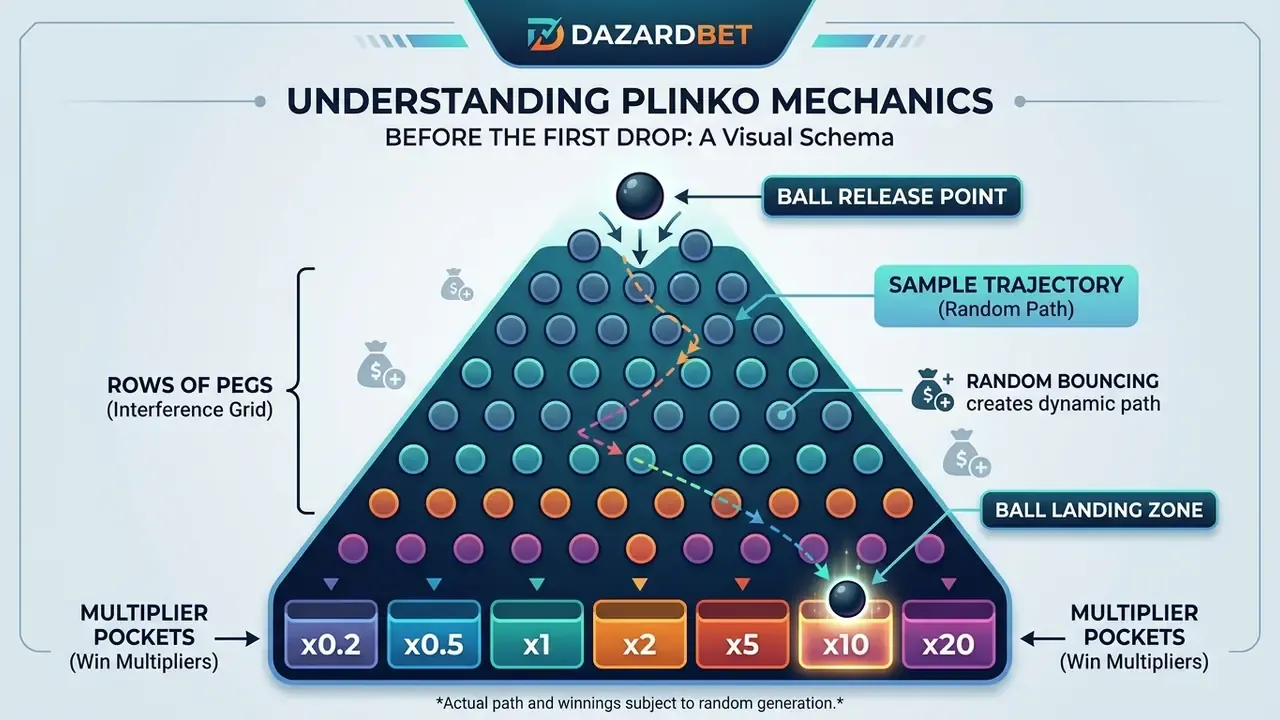
The board is a Galton board, the same apparatus used to demonstrate the normal approximation to the binomial distribution. The ball starts at the apex. At each row of pegs it is deflected either left or right, and in a correctly implemented game each deflection is an independent 50/50 event. After n rows the ball has made n binary decisions, and the pocket it lands in is determined by how many of those decisions went right.
That produces a binomial distribution over the pockets, which is why the payout grid is shaped the way it is: low multipliers crowded in the centre, extreme multipliers isolated at the edges.
Worked example for a 16-row board (17 pockets):
- Probability of the ball reaching one specific outer pocket = (1/2)^16 = 1 / 65,536, roughly 0.0015%.
- Probability of the three central pockets combined = [C(16,8) + C(16,7) + C(16,9)] / 65,536 = (12,870 + 11,440 + 11,440) / 65,536 = 35,750 / 65,536, about 54.5%.
«Each peg splits the ball's path exactly 50/50. Final pocket frequencies therefore follow the binomial law: for 16 rows, one extreme pocket occurs once in 65,536 drops, or 0.0015%. That is precisely why the edges pay x555 to x1,000 while the centre pays 0.2x to 0.5x.»
Methodological note: the "roughly 54% of balls land in the three central pockets" figure circulates in vendor guides without independent audit. We have not taken it on trust. The 54.5% above is derived directly from the binomial coefficients for a 16-row, unbiased board. If a specific title weights its pegs differently, that figure changes, and only a certification report from a testing laboratory can confirm the real distribution for that build.
Changing the number of rows changes the shape of the distribution, not the fairness of it:
- Fewer rows (8 to 12): the base of the pyramid is narrow, drops concentrate near the centre, outcomes are more consistent and volatility is lower.
- More rows (14 to 16): the base widens. It becomes materially harder for the ball to reach the outer pockets, but the multiplier values available in those pockets rise sharply.
2.3 Risk Levels, Multipliers and What They Do to Your Session
Risk level is the second lever, and it is often misread. Low risk keeps central pockets near 0.5x to 1x and trims the edges. High risk cuts central pockets to as little as 0.2x and pushes the outer pockets far higher.
Spribe expresses this with three coloured drop buttons: green, yellow and red. BGaming and Stake Originals use Low, Normal and High. Same logic, different labels.
Here is the part that matters for real money. Risk does not change the theoretical return. It changes how your bankroll travels. A green board on 12 rows will feel almost flat for long stretches. A red board on 16 rows can eat 40 units before it returns anything above your stake, and it can also, rarely, hand back a x555 pocket in one drop.

2.4 Variants of Plinko Online and Casino Plinko
The format is now a family rather than a single game. Seasonal reskins (Xmas Plinko, Easter Plinko, Plinko 2 Halloween), sports themes (Football Plinko), high-ceiling variants (Plinko X, Plinko Blitz) and hybrid slot-plus-Plinko titles (Pine of Plinko, which has a genuine bonus round) all coexist. BGaming is frequently highlighted for offering 99% RTP across several variants. If you want to compare live lobbies, our casino Plinko coverage tracks which operators carry which builds.
A frequent and consequential error in published reviews is attributing one studio's specifications to another. To be explicit: 97% RTP and a x555 cap belong to Spribe. 99% RTP and a x1,000 cap belong to BGaming. Several widely read reviews list a Spribe game while tagging BGaming in the metadata, which leaves readers with numbers that do not match the game they are actually loading.
2.5 Provider Comparison: Which Plinko Are You Actually Playing?
| Parameter | BGaming | Spribe | Stake Originals | Hacksaw (Pine of Plinko) |
|---|---|---|---|---|
| RTP | 99% | 97% | 99% | 96.48% |
| Max multiplier | x1,000 | x555 | x1,000 | x10,000 |
| Row range | 8 to 16 | 12, 14, 16 | 8 to 16 | Fixed board / bonus format |
| Risk levels | Low, Normal, High | Green, Yellow, Red | Low, Medium, High | Configurable |
| Signature feature | Line count changed in one click, plus a results record table | Three coloured drop buttons, one per risk tier | Custom auto-bet scripting, on-site provably fair page | Has an actual bonus game |
| Bet range | Operator-dependent | 0.10 to 100.00 | Operator-dependent, crypto-friendly | Operator-dependent |
To hit Spribe's ceiling you need the board set to 16 rows and a red ball landing in the extreme left or right pocket. That pays x555. On BGaming and Stake boards the equivalent extreme pocket on 16 rows at high risk pays x1,000.
2.6 The Full Payout Grid: 8 to 16 Rows, All Risk Levels
Ranges below run from the lowest central multiplier to the highest edge multiplier on a standard 8 to 16 row implementation.
| Rows | Low risk (centre to edge) | Medium risk (centre to edge) | High risk (centre to edge) |
|---|---|---|---|
| 8 | 0.5x to 5.6x | 0.4x to 13x | 0.2x to 29x |
| 9 | 0.7x to 5.6x | 0.5x to 18x | 0.2x to 43x |
| 10 | 0.5x to 8.9x | 0.4x to 22x | 0.2x to 76x |
| 11 | 0.7x to 8.4x | 0.5x to 24x | 0.2x to 120x |
| 12 | 0.5x to 10x | 0.3x to 33x | 0.2x to 170x |
| 13 | 0.7x to 8.1x | 0.4x to 43x | 0.2x to 260x |
| 14 | 0.5x to 7.1x | 0.2x to 58x | 0.2x to 420x |
| 15 | 0.7x to 15x | 0.3x to 88x | 0.2x to 620x |
| 16 | 0.5x to 16x | 0.3x to 110x | 0.2x to 1000x |
Read the grid together with §2.2. A 16-row high-risk board offers x1,000, but that pocket is a 1-in-65,536 event per side. A 16-row low-risk board caps at x16 while returning something at or near your stake in the majority of drops. Neither configuration changes the theoretical RTP. They change the shape of your results.
Spribe's colour tiers behave the same way: green keeps central pockets near 0.5x to 1x with modest edges, yellow drops the centre a little and lifts the mid-to-outer pockets, and red reduces central pockets to as low as 0.2x in exchange for the x555 ceiling.
3. Plinko Demo and Free Play
3.1 What Demo Mode Does and Does Not Do
Demo mode, sometimes labelled "fun" mode, loads the same game client with a virtual balance. There is no deposit, no wager, no withdrawal, and therefore no financial obligation between player and operator. It is genuinely useful for three things: learning the interface, seeing how row count and risk level reshape the multiplier grid, and observing how long a losing run can be at high volatility before your patience or your notional balance runs out.
What plinko demo cannot do is preview real-money results. Precise technical limits of demo builds, such as round caps, starting balance, whether the RTP served in demo is identical to the cash build, and whether autoplay speed is throttled, are not documented in public primary sources for most Plinko titles. We flag this as an area where operators should publish data rather than expect readers to assume parity.
3.2 What You Can Actually Test in Free Plinko
Free plinko is a laboratory, not a rehearsal. You can test:
- how many rows you can watch without losing track of the drop;
- how a red or high-risk grid feels across 100 drops instead of 10;
- whether stop conditions in auto mode behave as advertised;
- how quickly the interface lets you spend, once a real balance replaces the fake one.
You cannot test luck. There is no skill layer to build.
3.3 Experimental Evidence on Demo Modes and Risk-Taking
This is where the broader literature becomes directly relevant to plinko demo and free modes. Free play is not neutral. It can calibrate expectations upward before any money is at stake.
«Participants exposed to inflated RTP in demonstration mode placed significantly larger bets in subsequent real-money play.» Frahn, Delfabbro & King, Cyberpsychology, Behavior, and Social Networking (2015). https://www.ncbi.nlm.nih.gov/pmc/articles/PMC4442568/
Source correction: earlier versions of this claim circulated in commercial Plinko guides that paraphrased the finding without citing it. A promotional guide is not an acceptable source for a behavioural research claim. The finding above is cited directly to the peer-reviewed study, and readers can check the methodology themselves.
The practical implication for Plinko is specific. If a demo build serves a friendlier distribution, or if you simply happen to run hot across a few hundred free drops on a 16-row red board, then the anchor you carry into cash play is built from a favourable sample, not from the game's expectation.
3.4 Free Play Versus Cash Play
Research comparing free-play and cash-play conditions has examined what actually pushes a player across the line. Reilly found that participants in the free-play and cash-play conditions reported significantly higher perceived performance than participants who observed only.
«Perceived performance was the only significant predictor of choosing to play for money; the logistic regression model explained approximately 20% of the variance.» Reilly, T., PhD dissertation, Edith Cowan University (2024). https://ro.ecu.edu.au/theses/2860/
In other words: how well players thought they were doing predicted migration to cash play, independently of how well they were actually doing. That is a direct warning about "testing a strategy" in Plinko demo. You are not testing the strategy, because the strategy has no effect on the distribution. You are testing how confident a good run makes you feel.
3.5 Adolescents, Simulated Gambling and Monetary Gambling
Simulated gambling, meaning free casino-style games, social casino apps and gambling-themed mini-games inside video games, sits at the centre of Australian classification debates. The reason is simple: youth who play simulated gambling games are more likely to participate in monetary gambling later.
«Adolescents who played simulated gambling games at 16 to 17 years were around 40 percentage points more likely to have gambled with money at 18 to 19 years.» AGRC submission, Guidelines for the Classification of Computer Games (2023). https://www.classification.gov.au/sites/default/files/2023-03/agrc-submission-computer-games-guidelines.pdf
The adult picture is similar in direction, if smaller in magnitude. Longitudinal follow-up of social casino players found that roughly 26.3% had migrated to online monetary gambling when recontacted six months later.
«Around 26.3% of social casino gamers had migrated to online monetary gambling within the six-month follow-up period.» Health New Zealand, The Convergence of Simulated Gambling, Monetary Gambling and Gaming (2025). https://www.health.govt.nz/system/files/documents/publications/2025-convergence-simulated-gambling.pdf
A caveat on that figure. The 26.3% is reported inside a regulatory synthesis rather than as a fresh primary dataset, so the underlying cohort, attrition rate and definition of "migration" should be read in the original report before the number is used as a hard benchmark. We cite it because it is the clearest published quantification available, not because it is beyond challenge.
3.6 Australian Regulatory Perspective on Simulated Gambling
The Australian Gambling Research Centre's classification submission supports a proposed new mandatory minimum classification of R18+ for all simulated gambling games. In plain terms, that means treating gambling-style play mechanics as adult content regardless of whether money changes hands. For the wider regulatory context around licensing, advertising and payment restrictions, see our iGaming regulation analysis.
Two consequences follow for anyone reading a Plinko guide from Australia. First, "it's only a demo" is not a regulatory defence in the eyes of the research community. Second, interactive gambling law in Australia targets the operator, not the player, which is why offshore-licensed sites remain accessible while offering no Australian consumer-protection pathway if a withdrawal is refused.

3.7 A Practical Demo-Mode Test Checklist
If you are going to play plinko free, use it as an instrument rather than as entertainment. Test hypotheses, and write down results:
- Volatility mapping. Run 200 drops at 16 rows / low risk and 200 at 16 rows / high risk with identical notional stakes. Record the longest run of sub-1x outcomes in each.
- Distribution check. Tally landing pockets over 500 drops on a 16-row board and compare the central-three share against the theoretical 54.5%.
- Auto mode behaviour. Confirm whether stop-on-win, stop-on-loss and stop-after-N-rounds limits exist, and whether they actually halt the sequence.
- Speed and turnover. Time 100 drops. Multiply by your intended real stake to see hourly turnover before you deposit anything.
- Bankroll survival. Set a notional bankroll of 100 units and a 1-unit stake. See how many high-risk sessions end at zero.
- Interface traps. Check whether bet size resets, doubles or persists after a manual stop.
Six tests, maybe twenty minutes. Cheaper than learning the same lessons with a deposit.
4. Plinko for Real Money
4.1 Choosing a Safe Casino for Plinko
Three checks, in this order.
- Licence. Look for a verifiable licence number and issuer. A Malta Gaming Authority licence sits inside an EU-style compliance regime with defined operator obligations. A Curaçao licence sits inside an offshore framework with different scope and different public-register access. BGaming's own supplier licence, for example, is issued by the MGA as a B2B critical gaming supply licence. A supplier licence is not the same thing as the operator's licence, and both should be present.
- Original software. The game must run on the provider's own platform or API, with the provider name and game title matching the official vendor catalogue. Reskinned clones of Plinko with unpublished maths are the single biggest red flag in this category, because the multiplier grid can be altered without any certification trail.
- Provably fair or certified RNG. The game should expose server seed, client seed and nonce, along with a verification method (see §7). If those fields are absent, no independent fairness check is possible, and you are relying entirely on the operator's word.
4.2 Deposits, Withdrawals and Verification
Plinko is popular at crypto-first casinos, so deposit rails typically include BTC, ETH, USDT and LTC alongside cards, e-wallets and vouchers depending on jurisdiction. Before depositing, confirm four things: minimum and maximum deposit, minimum withdrawal, expected processing time, and the KYC documents required for withdrawal rather than for registration. A cashier that accepts money instantly but requests identity documents only at cash-out is where most complaint threads begin.
Bonus terms deserve equal scrutiny. Because Plinko often carries 97% to 99% RTP, many operators either exclude it from wagering contribution or count it at a reduced rate. A x1 playthrough on paper can be worthless if Plinko contributes 0%. Check game weighting, max bet while a bonus is active, expiry, and any max cashout cap. Those four lines decide the real value of an offer, not the headline percentage.
4.3 Bet Size, Multipliers and Potential Wins
Your total exposure per session is stake, multiplied by drops per hour, multiplied by hours. On a 16-row board a fast player can complete several hundred drops an hour, and auto mode can complete thousands. At 99% RTP the expected cost of 1,000 drops at a $1 stake is $10. But the distribution around that $10 is enormous at high risk, which is the point most guides skip.
Because players choose rows, risk and stake, and because Plinko boards often display a results history table, the game invites pattern-seeking. This can foster illusions of control and encourage strategies that, in reality, do not change the underlying probabilities.
«Social casino players who transitioned to monetary gambling displayed higher levels of illusion of control over random outcomes.» Wohl et al., cited in Health New Zealand, The Convergence of Simulated Gambling, Monetary Gambling and Gaming (2025); original: Bednarz et al. (2013). https://www.health.govt.nz/system/files/documents/publications/2025-convergence-simulated-gambling.pdf
A results table is a log, not a signal. Each drop is independent. Ten central pockets in a row do not make an edge pocket "due".
4.4 Responsible Gambling and Financial Risk
Disclaimer: This information is general in nature and does not replace professional advice. Playing for real money carries financial risk, and rules for casino plinko differ by operator and by jurisdiction, so check both before you stake anything. If you are experiencing problems with gambling, contact a support helpline. In Australia, Gambling Help Online is available 24/7 on 1800 858 858. 18+ only.
Practical controls that actually work, because they act on behaviour rather than on probability:
- Deposit limits, daily, weekly or monthly, set before the first session and not after the first loss.
- Loss limits and session timers. A fixed stop is the only reliable defence against chasing.
- Time-outs and self-exclusion. Temporary account suspension is standard at licensed operators.
- Reality checks, meaning on-screen prompts showing elapsed time and net position.
- Never gamble with money allocated to rent, bills, debt or savings. Plinko is entertainment expenditure, not income.
5. RTP, Volatility and the Mathematics of Plinko
5.1 RTP by Provider, and What the Number Means
RTP is the long-run average return per unit staked, computed across the full probability distribution of the board. BGaming specifies 99% for Plinko with 8 to 16 rows and three risk levels. Spribe specifies 97% with 12, 14 or 16 rows. Hacksaw's Pine of Plinko sits at 96.48% but adds a bonus feature and a x10,000 ceiling. Higher RTP means a lower house edge over a very large number of drops: 1% of turnover at 99%, and 3% at 97%.
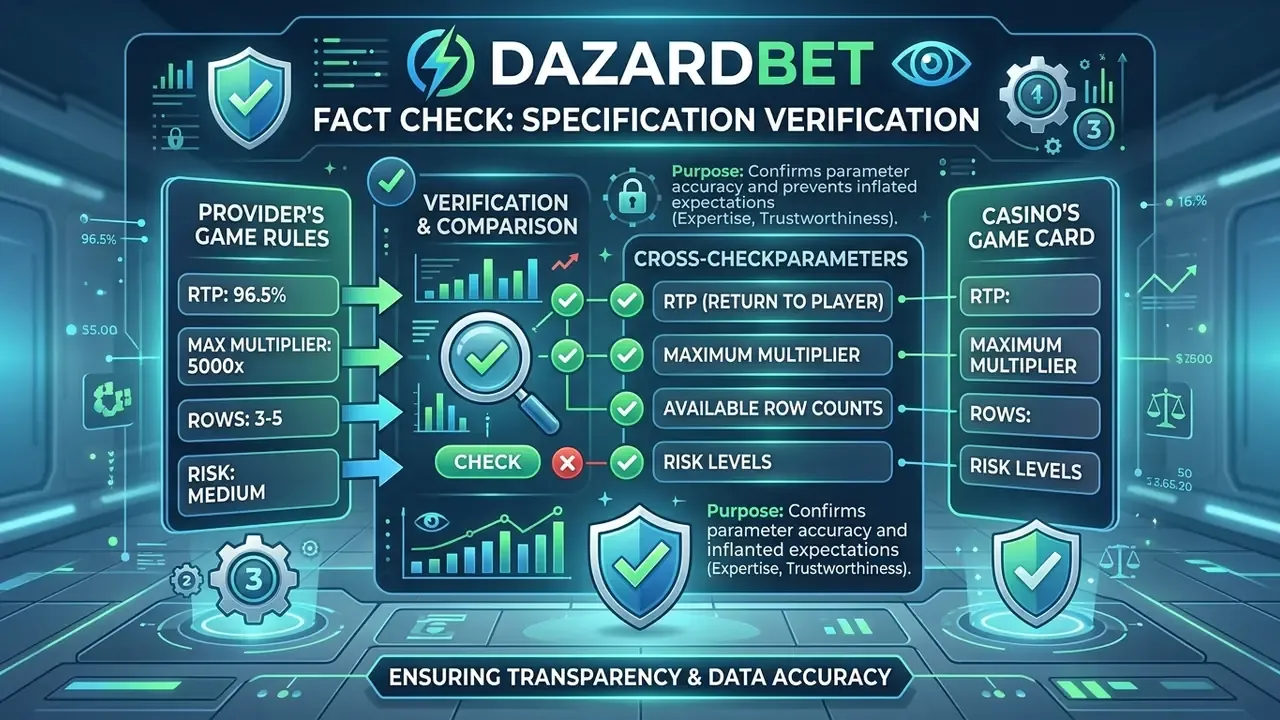
One verification caveat we will not paper over. These figures come from vendor specifications and operator game cards. Independent confirmation requires a certification report from an accredited testing laboratory, and such reports are rarely published publicly. Treat vendor RTP as a specification, not as an audited measurement, and cross-check the game card in the lobby against the studio's own catalogue.
5.2 Variance: Why 99% RTP Does Not Protect a Session
RTP describes an expectation as the number of drops approaches infinity. Session results are governed by variance around that expectation.
- The standard error of your average return over n drops is σ/√n. With a small n, swings dominate.
- Two boards with identical RTP can produce radically different sessions. A low-risk 16-row board clusters tightly around the mean, while a high-risk 16-row board produces long negative runs punctuated by rare large multipliers.
- At 16 rows on high risk, roughly 54.5% of drops land in the three central pockets paying about 0.2x. A player can therefore lose 80% of a bankroll while the game performs exactly to specification.
This is the single most important sentence in the article: 99% RTP with high volatility is not "safe"; it is cheap on average and brutal in the short run.
5.3 Why Strategy Cannot Beat the House Edge in Plinko
No matter how the player changes bet size, risk level or row count, the expected value of each drop remains below the stake. This is not opinion. It follows from the construction of the board. Expected return = Σ (pocket probability × pocket multiplier), and each published grid is built so that this sum equals the advertised RTP, 0.99 or 0.97 of stake, never above 1.00. Changing rows or risk swaps one grid for another grid with the same sum. There is no configuration in the game menu that produces a positive expectation, because none is offered.
Supporting evidence and its limits. The arithmetic above is self-verifying: take any published grid, compute the binomial probabilities, multiply, then sum. What does not exist in the peer-reviewed literature is a Plinko-specific study of staking systems. So where this guide describes progression systems, we rely on general probability theory and on the behavioural findings cited elsewhere in this article. We flag that gap rather than dressing general gambling research up as Plinko-specific data.
Martingale strategies eventually fail when a long run of sub-1x outcomes occurs, wiping out the bankroll or colliding with the table's maximum bet. Three structural reasons, specific to Plinko:
- There is no binary win or loss. Pockets paying 0.2x, 0.3x and 0.5x return part of the stake. "Doubling after a loss" is undefined when a "loss" returns 20% of the wager. Do you double to recover the whole stake, or the 80% shortfall?
- Payouts are not 2.00. Martingale's recovery logic assumes an even-money outcome. A fractional multiplier grid breaks the recovery arithmetic entirely.
- Table limits and finite bankrolls bind. Doubling from $1 hits four figures inside eleven steps. On a 16-row high-risk board, an eleven-drop run of central pockets is unremarkable, since the central three pockets alone occur 54.5% of the time.
Again, no published study measures Martingale specifically on Plinko boards. We present the mechanism, not a fabricated statistic.
6. Plinko Strategy and Bankroll Management
6.1 Plinko Strategy: What Can Be Controlled
Your controllable inputs are exactly four: stake size, row count, risk level and number of drops. Everything else, the deflection at each peg and the final pocket, is generated by the RNG or by the provably fair seed chain. There is no drop-timing trick, no hot-and-cold window, no pattern in the history table.
So plinko strategy is volatility and bankroll management, not edge creation. And the biggest single variable is not the board at all. It is the player.
«Participants scoring high on negative urgency and positive urgency were more likely to move to monetary gambling regardless of their social casino outcome.» Health New Zealand, The Convergence of Simulated Gambling, Monetary Gambling and Gaming (2025). https://www.health.govt.nz/system/files/documents/publications/2025-convergence-simulated-gambling.pdf
Dispositional traits play a significant role in whether players gamble following social casino or simulated gambling exposure. If you know you act impulsively after both wins and losses, pre-committed deposit and loss limits are worth more than any board configuration.
6.2 Two Workable Bankroll Frameworks
Neither of these produces profit. Both control drawdown and session length, which is what "strategy" can legitimately mean here.
Method 1, the low-risk pyramid. Board: 14 to 16 rows, green or low risk. Stake: 1% to 2% of bankroll per drop. Objective: long sessions in which frequent 1.1x to 2.3x pockets keep turnover moderate and drawdown shallow, capturing the 98% to 99% RTP with minimal variance. Expect small results in both directions and a session that lasts.
Method 2, the high-volatility hunt. Board: 16 rows, red or high risk. Stake: 0.1% of bankroll per drop, which is a deliberately tiny unit. Mode: auto for 500 to 1,000 drops. Objective: survive enough drops for the x110 to x1,000 tail to be reachable at all. The arithmetic is unforgiving, because the extreme pocket is 1 in 65,536 per side, so this is a lottery-ticket approach and should be budgeted as one.
Universal rules. Divide the bankroll into sessions before you start. Never stake an entire bankroll on one drop. Decide your stop-loss and stop-win in advance, then honour both. Record results, because memory over-weights wins.
6.3 Myth-Busting: Systems That Do Not Work
| Claim commonly published | Reality |
|---|---|
| "Martingale: double after each loss, reset after a win. Ideal for lucky streaks." | Mathematically inapplicable to a fractional multiplier grid, and structurally limited by table caps and finite bankrolls (see §5.3). |
| "Anti-Martingale: raise stakes after a win." | Changes variance only. Independent drops have no momentum. |
| "Track the results table to find the luckiest time to bet." | The results table is a log of independent events. No temporal edge exists. |
| "More rows means bigger winnings." | More rows means bigger available multipliers and lower probability of reaching them. Expectation is unchanged. |
| "Demo practice improves real-money results." | Demo practice improves familiarity with the interface. Published research links it instead to inflated perceived performance and larger subsequent bets (§3.3 to §3.4). |
| "Flat betting is a strategy." | Flat betting is a discipline. It is the most defensible approach precisely because it makes no claim to beat the maths. |
- How to Verify a Provably Fair Plinko Round, Step by Step
Provably fair systems let you confirm, after the round, that the operator did not alter the outcome. Most guides mention the phrase and move on. Here is the actual procedure.
1
Open the game's History / Provably Fair panel and select the specific drop you want to check.
2
Copy the Server Seed. Before the round it is shown only as a SHA-256 hash; after you rotate or reveal your seed pair, the unhashed server seed is published. Confirm that hashing the revealed server seed reproduces the hash you were shown before betting. This is the step that proves the server committed in advance.
3
Copy the Client Seed, the browser-side or user-set seed. Many platforms let you set this manually, which strengthens the guarantee.
4
Note the Nonce, the sequential index of that drop within the seed pair.
5
Concatenate the values in the platform's documented order, typically Server Seed : Client Seed : Nonce, and compute the SHA-256 hash using any independent calculator.
6
Convert the leading bytes of the resulting hex digest into a decimal value using the platform's published divisor. That number maps to the left/right sequence through the pegs, and therefore to the landing pocket.
7
Compare the reconstructed pocket with the pocket the game displayed. A match confirms the round. A mismatch is grounds for a formal complaint to the operator and its licensing authority.
If a Plinko game does not publish server seed, client seed, nonce and a verification formula, it is not provably fair, whatever the marketing copy says. At best it is running certified RNG, which is auditable by a laboratory but not by you.
8. Regional Models, Devices and Vulnerable Players

8.1 Real Money Versus Sweepstakes: Two Different Products
Confusing these two models is the fastest way to read advice that does not apply to you.
- Sweepstakes or social model, widely used across the United States and parts of Canada. Play uses two currencies: Gold Coins, a purely entertainment currency with no redemption value, and Sweeps Coins, which can be redeemed for prizes or cash under promotional-sweepstakes rules. No direct deposit is required to obtain an initial allocation, which is why these platforms operate in states where real-money online casinos are restricted. Age gates vary by operator and state, commonly 18+ or 21+, and availability is excluded in a list of states.
- Real-money model, used in Australia, Europe and most other regions. Play uses direct deposits in fiat or cryptocurrency (BTC, USDT and others) at casinos licensed by bodies such as the MGA or Curaçao. Wins are withdrawable cash, wagering requirements and KYC apply, and financial risk is immediate and real.
The same Plinko board can appear in both models. The maths is identical. The legal wrapper, the currency and the consumer protections are not.
8.2 The Australian Position
Australian players commonly encounter Plinko at offshore-licensed operators. Interactive gambling legislation in Australia is directed at operators rather than at individual players, which is why these sites remain reachable. It also means an Australian player has no domestic regulator to appeal to if a payout is withheld.
Before depositing, verify the licence number on the regulator's own register, read the withdrawal terms, and treat the absence of a published complaints pathway as disqualifying. Some Plinko titles are also offered by Australian-facing operators as demo-only, which sits squarely inside the R18+ classification debate discussed in §3.6.
8.3 Plinko Mobile, Plinko App and Plinko Download: HTML5 Versus APK Safety
Most Plinko builds are HTML5 and run in the mobile browser without installation, on both iOS and Android, with a touch-optimised interface and full access to the cashier and promotions. So in practice, plinko mobile play needs no plinko download at all. A native plinko app adds push notifications and biometric login, but distribution is inconsistent, and many offshore operators are absent from the official app stores.
That gap is where the risk lies. Sideloading an APK from a link in an email, chat message or affiliate page means installing unsigned code from an unverified publisher, with device-level permissions attached. If you do install an app, take it from the operator's own HTTPS domain or an official store, check the publisher name, and prefer the browser version when in doubt.
We could not locate independent security testing of casino Plinko APKs, so this recommendation is precautionary rather than evidence-based. Precaution is the correct default when the download is unsigned.
8.4 Auto Mode Versus Manual Mode
Manual mode drops one ball per click. It is slower, and slower is cheaper: fewer drops per hour means less turnover exposed to the house edge, and it keeps you in the loop for every decision.
Auto mode runs a preset number of drops, sometimes with stop-on-profit, stop-on-loss and stake-adjustment rules. It is the fastest way to accumulate turnover, and therefore the fastest way to realise the house edge. If you use it, set the round count and the stop conditions before starting, then confirm during a demo session that those stop conditions actually fire. Some builds also expose a results record table, which is useful for logging and useless for prediction.
8.5 Adolescents Who Play and Spend Money in Simulated Gambling
Plinko's arcade aesthetic, with bouncing balls, bright pockets and no card iconography, makes it one of the least "gambling-looking" gambling products. That is exactly why the adolescent research matters. Studies of youth simulated-gambling participation report substantial time commitment and non-trivial spending, with expenditures ranging from AUD 13 to AUD 150 depending on the sample.
«Adolescents spent an average of 9 to 13 hours per month on simulated gambling, with expenditure ranging from AUD 13 to AUD 150.» Adolescents Who Play and Spend Money in Simulated Gambling, PMC. https://www.ncbi.nlm.nih.gov/pmc/articles/PMC8617462/
Read alongside the AGRC's 40-percentage-point finding in §3.5 and the 26.3% adult migration figure, the pattern is consistent: free gambling-style play is a pathway, not a firewall. Parental controls, store-level age restrictions and device-level purchase locks are the practical response. Treating a free Plinko board as harmless because no money is displayed is not.
9. Who Should Skip Plinko Altogether
A short, blunt block, because most guides never write one.
Skip it if you are chasing losses from another game today. Skip it if the bonus you are eyeing excludes Plinko from wagering, since you will be spending real money for zero playthrough credit. Skip it if the casino publishes no licence number, no complaints pathway and no seed verification page.
Skip it, too, if you enjoy the results table a bit too much. Pattern-hunting on a 16-row board is a fast route to spending more than planned.
And if you do play, treat the low-risk grid as the default and the red board as the exception.
- Plinko FAQ
A casual, arcade-style casino game in which a ball drops through a triangular grid of pegs and lands in a multiplier pocket. Your payout is your stake multiplied by that pocket's value. Rounds are independent, and there are no paylines, symbols or free spins.
BGaming and Stake Originals specify 99%, Spribe specifies 97%, and Hacksaw's Pine of Plinko sits at 96.48% with a bonus feature. Higher RTP means a smaller theoretical house edge over a very large number of drops. It does not make any single session safer.
Plinko Classic is the stripped-back build: one board, adjustable rows, three risk tiers, no bonus round and no progressive jackpot. Spribe's version fixes rows at 12, 14 or 16 and caps at x555. BGaming's classic board runs 8 to 16 rows with a x1,000 ceiling and a results record table.
Themed and hybrid games change more than the artwork. Pine of Plinko adds a real feature round and a x10,000 cap at 96.48% RTP, while Plinko X and Plinko Blitz rework multipliers and pace. Compare rows, risk labels, top multiplier and RTP on the game card, because those four fields tell you which family you are in.
It depends on the build: x555 on Spribe's Plinko Classic (16 rows, red ball, extreme outer pocket), x1,000 on BGaming and Stake Originals at 16 rows on high risk, and up to x10,000 on some Hacksaw and third-party variants. On a 16-row board, one specific extreme pocket occurs about once in 65,536 drops.
Fewer rows, 8 to 12, concentrate outcomes near the centre for steadier, lower-variance play. More rows, 14 to 16, widen the board, raising the top multipliers while making them much harder to reach. Neither changes the theoretical RTP.
No. You control stake, rows, risk level and number of drops, and none of those produces a positive expectation, because every published multiplier grid sums to an RTP below 100%. Martingale in particular is inapplicable, since fractional pockets like 0.2x and 0.5x mean there is no clean binary "loss" to double against.
Many versions are. Open the game's Provably Fair panel, verify that the pre-round server-seed hash matches the revealed server seed, then combine server seed, client seed and nonce, hash with SHA-256, and convert the leading digits to decimal to reconstruct the ball's path. Full procedure in §7.
It improves your familiarity with the interface and the multiplier grid. It does not improve your odds. Research indicates that exposure to favourable free-play conditions is associated with larger subsequent real-money bets, and that perceived performance, not actual performance, predicts the move to cash play.
Australian players typically access Plinko at offshore-licensed operators, and Australian interactive gambling law is directed at operators rather than players. That means fewer consumer protections: verify the licence on the regulator's register, read the withdrawal and KYC terms in full, and understand that there is no domestic recourse if a payout is disputed.
Gold Coins are an entertainment-only currency with no redemption value. Sweeps Coins can be redeemed for prizes or cash under promotional-sweepstakes rules. This dual-currency model is used in the United States and parts of Canada, where real-money online casino play is restricted, and it does not apply to Australian or European real-money casinos.
Spribe's specification lists 0.10 to 100.00 per drop. Operator-level minimums often start lower, from about AUD 0.01 to 0.10 depending on the casino and currency. Always check the specific game card in the lobby, since operators can configure limits.
Classic Plinko from Spribe, BGaming and Stake Originals has neither a progressive jackpot nor a bonus round, so the maximum multiplier functions as a de facto ceiling. Hybrid titles such as Pine of Plinko and some Olympus-themed variants do add bonus features or progressive elements.
Yes, when played for real money or for redeemable sweepstakes currency, because you stake value on a random outcome. Even in free mode, Australian research bodies argue it should be treated as adult content, which is the basis of the proposed R18+ minimum classification for simulated gambling games.

How We Reviewed This Game
Our desk checked provider specification pages, operator game cards and licensing registers, then recomputed the binomial figures from published multiplier grids rather than repeating vendor summaries. Behavioural claims are cited to peer-reviewed studies or to government publications, and gaps in the evidence are labelled as gaps.
Where a number could not be independently verified, we say so in the text. This page is reviewed on a rolling basis, and the last-reviewed date sits at the top.
Take your time with the terms before you decide anything. If Plinko stops being entertainment, use deposit limits, a time-out or self-exclusion.
General information only, 18+. Gambling involves risk of financial loss and no outcome is guaranteed. If gambling is causing harm to you or someone you know, contact Gambling Help Online on 1800 858 858 (Australia) or your local support service.